


This ETF Is Down 2.48% in 2026. Here's Why I'm Still Investing.
Key Points
The Vanguard Total Bond Market ETF is one of the best bond ETFs, but it has lost about 2.48% of its value in 2026 year-to-date.
Buying bonds can deliver valuable long-term benefits to your portfolio, even if the short-term losses and low yields feel frustrating.
Bonds are not always my favorite part of investing. They don't grow like stocks. They're not exciting, unless something has gone terribly wrong in the global economy. But buying bonds is like eating your vegetables: it's good for you, and you've got to make some room on your plate. (Actually, I love eating vegetables!)
The past few years were tough for bond investors, especially 2022, when the Fed hiked interest rates and bond prices plummeted. But 2026 is looking like another down year for bonds. So far this year, the Vanguard Total Bond Market ETF (NASDAQ: BND) is down about 2.48%.
Where to invest $1,000 right now? Our analyst team just revealed what they believe are the 10 best stocks to buy right now, when you join Stock Advisor. See the stocks »

Losing money on "safe" bond investments can feel frustrating, especially when the stock market is surging. But I'm going to keep buying the Vanguard Total Bond Market ETF.
Here are a few reasons why I'm sticking with bonds, Vanguard-style.
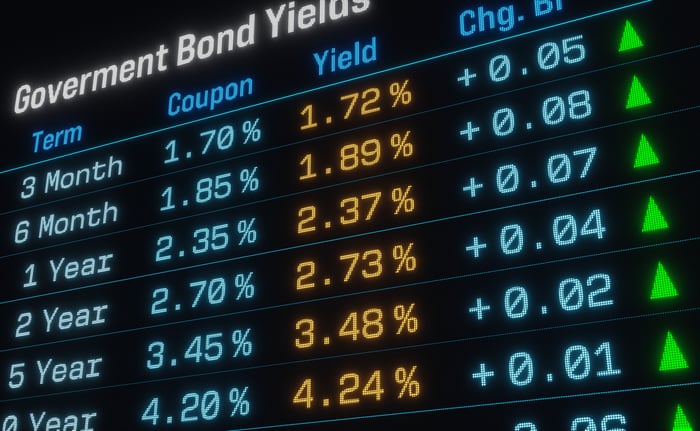
Image source: Getty Images.
1. Bonds are often considered "safe" compared to stocks
A classic rule of thumb in investing is that when stocks go down, bond prices tend to go up. When investors get scared by a stock downturn or an economic crisis, they often flee to safety by buying bonds, driving up prices (and driving down bond yields).
This doesn't always happen. In 2022, bonds and the S&P 500 index both declined. That was a bad year for investors. But in general, buying bonds is considered a "safe" way to avoid some of the risks associated with volatile stocks.
2. Bonds offer ballast in a portfolio
Speaking of volatility: I buy bonds to help balance my stock-heavy portfolio, just like using ballast to keep a ship steady at sea. Most of my money is in stocks, and that's fine. But everyone, as they get older and closer to retirement, should probably own some percentage of bonds, depending on their risk tolerance.
Your bond allocation doesn't have to be 40% (as in the classic 60/40 portfolio of 60% stocks, 40% bonds). But unless you're young and exuberantly willing to take risks with your investments, it probably shouldn't be 0%.
3. Bonds are part of an overall risk management approach
No matter how many bonds you have in your portfolio, I look at them as part of a bigger picture. Bond returns are not always exciting, and the Vanguard Total Bond Market ETF probably will not outperform an S&P 500 ETF in the long run.
But that's OK. Bonds serve an important purpose. Bonds are there to help my money stay steadier and (ideally) help my investments keep delivering strong returns as part of an overall portfolio.
Why buy the Vanguard Total Bond Market ETF
This bond ETF is ultra low-cost (with an expense ratio of 0.03%). It's simple and broadly diversified with 11,476 U.S. bonds of all kinds: Treasuries, corporate bonds, asset-backed securities, and more. Over the past 19 years, since its inception in April 2007, the Vanguard Total Bond Market ETF has delivered annualized returns of 3%.
I'm not trying to get fancy or take excess risk with my bond investments. But I believe that in the long run, buying this bond ETF will generally be a smart choice -- just like eating vegetables.
Ben Gran has positions in Vanguard Total Bond Market ETF. The Motley Fool has positions in and recommends Vanguard Total Bond Market ETF. The Motley Fool has a disclosure policy.