


If Warren Buffett Could Buy and Hold Only 1 ETF, Here's What History Says He'd Choose
Key Points
The S&P 500 ETF is Warren Buffett's most recommended ETF.
Over time, this fund could turn $200 per month into over $1 million.
Warren Buffett is famous for his stock picks, but his advice for the average investor is surprisingly simple: Invest in a fund that tracks the S&P 500 (SNPINDEX: ^GSPC).
There's a good reason the S&P 500 ETF carries Buffett's stamp of approval. Its long-term history is rock-solid, it offers ample diversification within a single fund, and with enough time, it could turn just a couple of hundred dollars per month into $1 million or more.
Where to invest $1,000 right now? Our analyst team just revealed what they believe are the 10 best stocks to buy right now, when you join Stock Advisor. See the stocks »
Here's how to decide whether this investment is a smart fit for your portfolio.
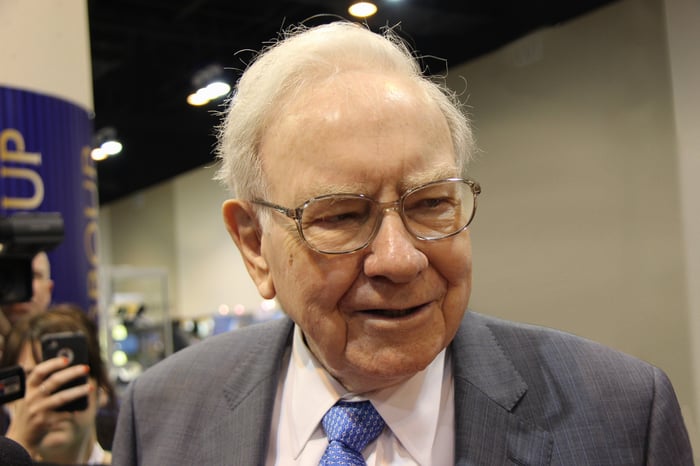
Image source: The Motley Fool.
The S&P 500 ETF is "the best thing" for most investors
During Berkshire Hathaway's 2020 annual meeting, Buffett noted that "for most people, the best thing to do is to own the S&P 500 index fund" when discussing how to choose investments.
This isn't the first time the famed investor has recommended this fund, either. In 2008, he famously bet $1 million that an S&P 500 fund could outperform a group of five hand-selected hedge funds over a 10-year period. His investment earned total returns of around 126% in that time, while the five actively managed funds averaged total returns of around 36%.
In 2013, he also revealed that upon his death, 90% of the cash bequest for his wife will be invested in an S&P 500 index fund -- specifically suggesting Vanguard.
Why invest in the S&P 500?
The S&P 500 ETF -- such as the Vanguard S&P 500 ETF (NYSEMKT: VOO) -- is about as close as you can get to guaranteed long-term returns. While nothing is 100% certain in the stock market, the S&P 500 has consistently earned positive total returns despite brutal short-term volatility.
In fact, every single one of the S&P 500's 20-year periods since 1919 has ended in positive total returns, according to analysis from Crestmont Research. For long-term investors willing to hold their investment for at least a decade or two, it's almost harder to lose money with an S&P 500 ETF than it is to make money.
Because the S&P 500 holds stocks from 500 of the largest U.S. companies, it also offers more diversification than many other funds. While nearly 40% of the Vanguard S&P 500 ETF is allocated to the information technology sector, it still offers exposure to large-cap stocks across all industries.
Turning $200 per month into $1 million
The S&P 500 ETF is known for its relative safety and stability, but it still packs a punch.
Historically, the S&P 500 has earned an average annual return of around 10%. At that rate, if you were to invest $200 per month, here's approximately how your savings would add up over decades:
| Number of Years | Total Portfolio Value |
|---|---|
| 20 | $137,000 |
| 25 | $236,000 |
| 30 | $395,000 |
| 35 | $650,000 |
| 40 | $1,062,000 |
Data source: Author's calculations via investor.gov.
If the S&P 500 continues to earn returns in line with its historical average, it would take around 40 years of consistently investing $200 per month to reach $1 million in total savings.
This is the trade-off with the S&P 500 ETF. It's a passive fund that requires minimal effort on your part, but it's also not as lucrative as many other investments. Although Warren Buffett highly recommends the S&P 500 for most investors, there's a reason why much of his own wealth comes from a portfolio of individual stocks.
Although the S&P 500 ETF may not be the highest-earning investment, it still offers long-term stability and consistency. For investors who are comfortable with average earnings in exchange for a hands-off fund with a strong track record, it could be a fantastic choice.
Katie Brockman has positions in Vanguard S&P 500 ETF. The Motley Fool has positions in and recommends Berkshire Hathaway and Vanguard S&P 500 ETF. The Motley Fool has a disclosure policy.