


Nomad Foods (NOMD) Stock May Be 50% Undervalued On Debt Refinancing Plans
Nomad Foods stock has delivered a roughly 47.8% decline over the past five years, yet current valuation checks and an intrinsic value estimate based on a Discounted Cash Flow (DCF) approach both indicate the shares trade at a discount to their assessed worth. That gap sits against a backdrop of recent refinancing plans and softer sales trends that could influence how much of that apparent discount investors are willing to recognize.
- Over five years the share price has fallen about 47.8%, which means long term holders have seen material capital erosion even before factoring in any valuation upside implied by current models.
- The planned €800m senior secured notes refinancing can support balance sheet visibility, although higher interest expense and pressure on sales and earnings may weigh on what investors are prepared to pay for Nomad Foods.
- Nomad Foods screens as undervalued on most of Simply Wall St's checks, with a value score of 5 out of 6, which indicates that the broader set of valuation measures leans cheap rather than expensive.
The key question now is whether the current discount to intrinsic value and earnings based measures offers enough compensation for the execution and refinancing risks around Nomad Foods.
Find out why Nomad Foods' -26.3% return over the last year is lagging behind its peers.
Is Nomad Foods a Bargain on Cash Flow?
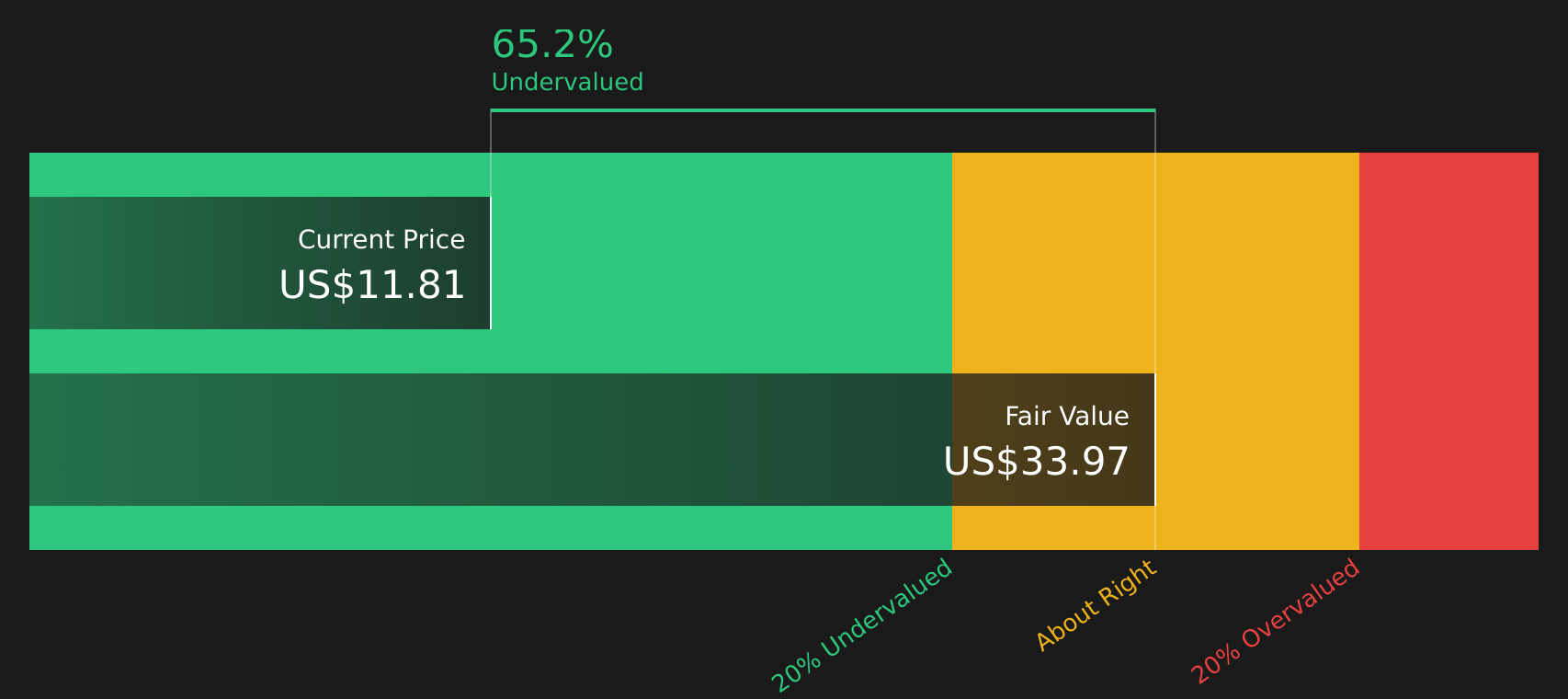
The Discounted Cash Flow (DCF) approach here looks at the cash Nomad Foods can generate for shareholders over time. On the latest figures, the company is producing roughly €239 million of free cash flow over the past twelve months, with the model assuming a generally declining path for future cash flows before they settle into a steady state. Even with those cautious cash flow expectations, the 2 Stage Free Cash Flow to Equity model points to an intrinsic value of about $24.31 per share.
That compares to a current market price that sits roughly 49.8% below this estimate. This result indicates that the DCF output identifies Nomad Foods as undervalued on cash flow alone. The planned €800 million debt refinancing, and the associated impact on interest costs and earnings guidance, helps explain why the share price may still sit well below this intrinsic value estimate.
Overall, the Discounted Cash Flow work indicates that Nomad Foods stock appears undervalued relative to the cash it is expected to generate.
Our Discounted Cash Flow (DCF) analysis suggests Nomad Foods is undervalued by 49.8%. Track this in your watchlist or portfolio, or discover 49 more high quality undervalued stocks.
Is Nomad Foods a Bargain on Earnings?
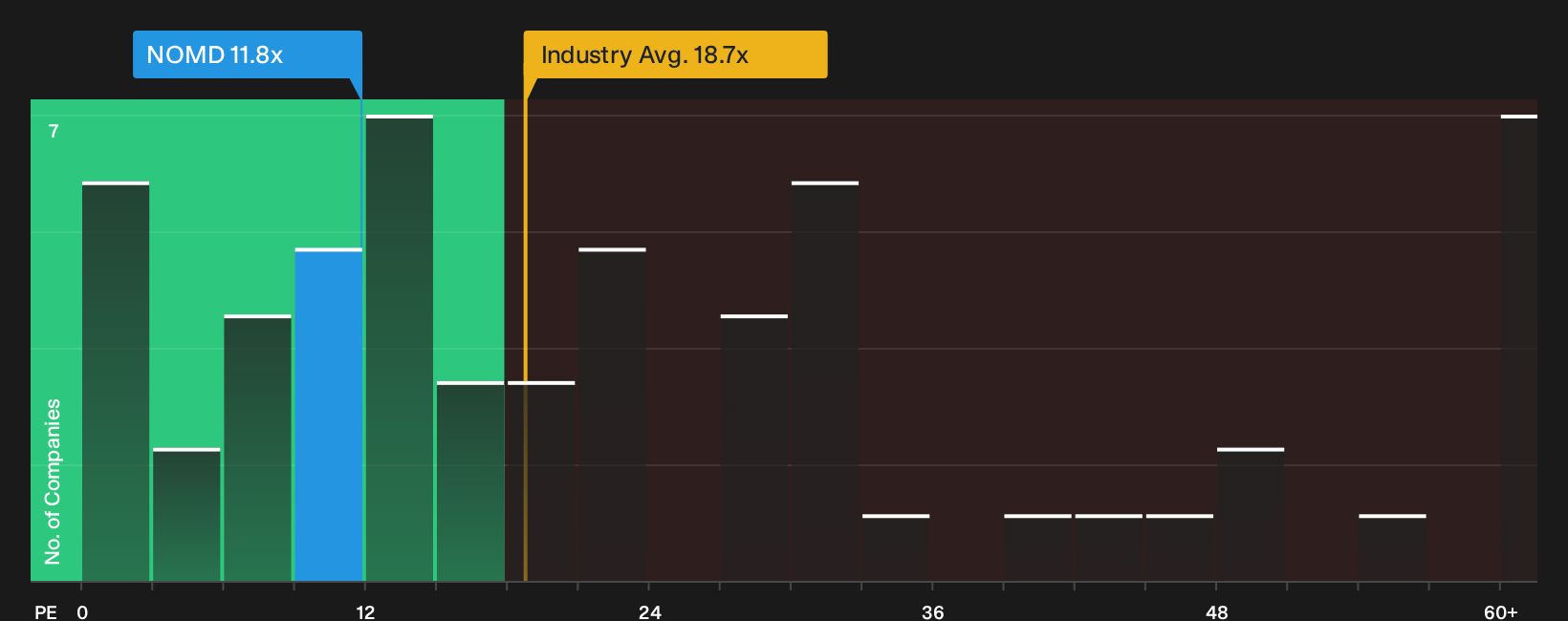
P/E is a useful lens for Nomad Foods because earnings are still a key reference point for how the market prices the stock. Nomad Foods currently trades on a P/E of about 11.3x, which sits well below the wider Food industry average of 17.8x and also below the peer group average of 42.1x. That already places the stock at a visible discount to both its sector and closer listed comparables.
The tailored fair P/E ratio for Nomad Foods is 16.9x, which reflects what investors might typically pay given its profitability profile, scale and risk factors. The gap between this fair ratio and the current 11.3x suggests the market is applying a heavier discount than that model implies. Recent discussion around refinancing costs and softer sales may be contributing to that lower multiple, even though the framework points to room for a higher earnings based valuation.
On the P/E multiple, Nomad Foods stock appears inexpensive relative to both its industry and its own modelled fair ratio.
See what the numbers say about this price — find out in our valuation breakdown.
The Nomad Foods Narrative: What Would Justify Today's Price?
Simply Wall St Narratives pick up where the valuation puzzle for Nomad Foods leaves off by spelling out which assumptions on growth, margins and earnings would need to hold for the stock to be worth materially more or less than today’s price, and they sit on the company’s Community page. Each one treats fair value as a thesis about how Nomad Foods' business might develop over time so you can see how that view holds up as new information arrives.
Community views on Nomad Foods sit far apart, with one side focusing on product and margin progress while the other leans into structural demand risks.
Bull case: 5% undervalued
"Resumption of volume growth (with market share gains even in challenging weather), supported by advancing digitalization and supply chain investments, sets the stage for higher sales and EBITDA as secular demand for convenient, sustainable food options recovers post-disruption…"
Read the full Bull Case to see why Nomad Foods could be undervalued
Bear case: 11% overvalued
"Even as the company has ramped up renovation to differentiate its branded products from rising private label competition, consolidation among retailers and an accelerating trend toward retailer own brands threaten to undermine Nomad Foods' pricing power and shelf presence, which could put sustained pressure on revenues and gross margins over the longer run…"
Read the full Bear Case to see why Nomad Foods could be overvalued
Do you think there's more to the story for Nomad Foods? Head over to our Community to see what others are saying!
The Bottom Line
Nomad Foods screens as undervalued on both the Discounted Cash Flow (DCF) work and its current earnings multiple, which are pointing in the same direction. The intrinsic value estimate sits well above the share price, while the P/E suggests the stock trades at a discount to peers and its own tailored fair ratio. With the broader checks also supportive, the real question is whether refinancing costs and pressure on sales and margins ease enough for that discount to close rather than signal a value trap. For investors, the crux is how confidently Nomad Foods can protect earnings power in the face of those risks.
This article by Simply Wall St is general in nature. We provide commentary based on historical data and analyst forecasts only using an unbiased methodology and our articles are not intended to be financial advice. It does not constitute a recommendation to buy or sell any stock, and does not take account of your objectives, or your financial situation. We aim to bring you long-term focused analysis driven by fundamental data. Note that our analysis may not factor in the latest price-sensitive company announcements or qualitative material. Simply Wall St has no position in any stocks mentioned.
Have feedback on this article? Concerned about the content? Get in touch with us directly. Alternatively, email editorial-team@simplywallst.com