


Dear Teradyne Stock Fans, Mark Your Calendars for July 28
If you own Teradyne (TER) stock, or you're thinking about buying it, the last week of July could be critical. Teradyne, the company behind the machines that test AI chips, memory, and networking gear, is about to show investors whether its blistering growth pace from earlier this year can continue. And based on what management has said in recent weeks, there's a lot riding on the answer.
Teradyne has quietly become one of the more interesting AI plays on Wall Street, given it manufactures the equipment that proves AI chips work before they are shipped to data centers. As AI hardware gets more complex, that job is getting bigger and more expensive for customers to skip.
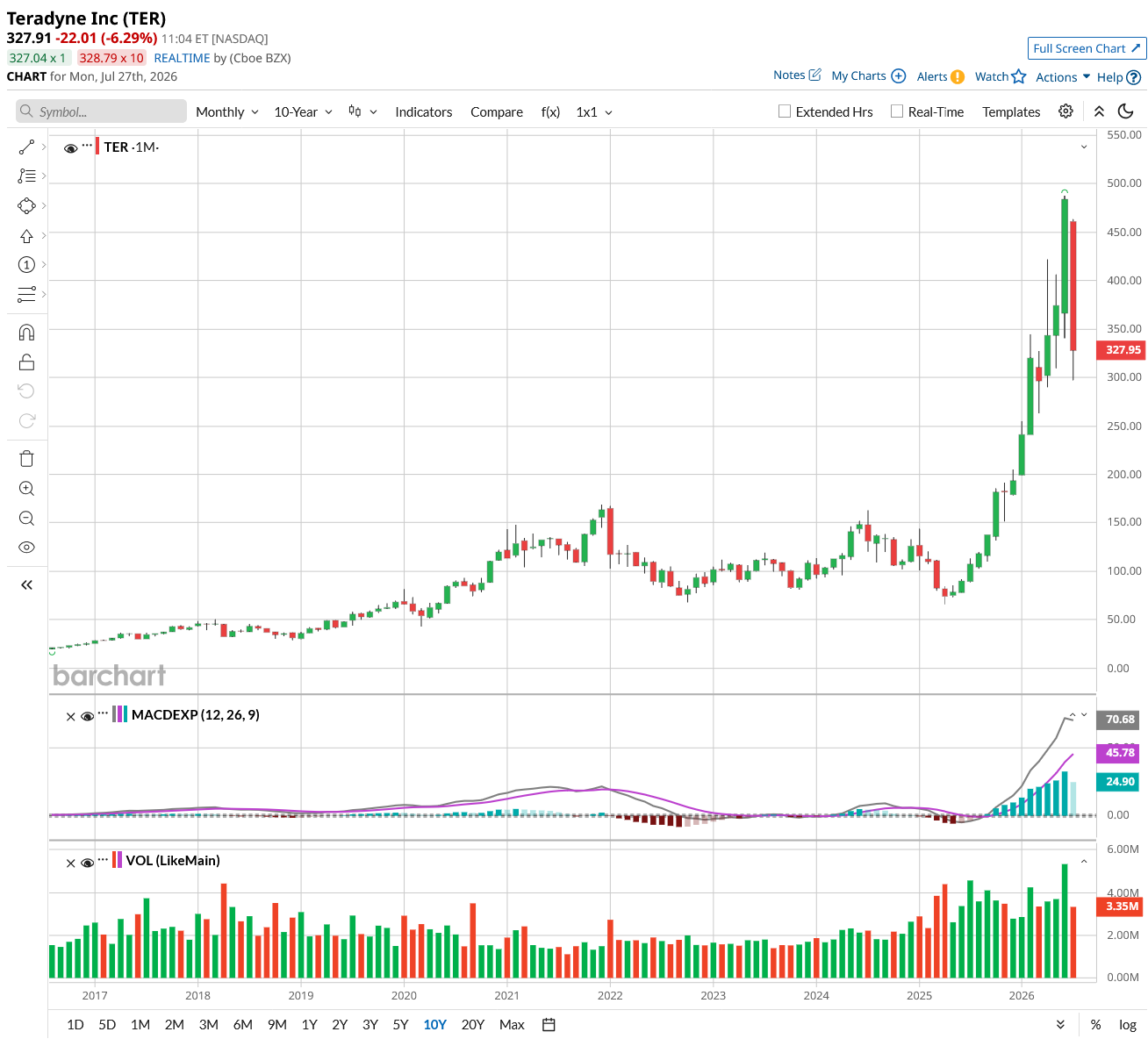
Teradyne’s AI Business Is Growing
In the first quarter of 2026, Teradyne posted revenue of about $1.3 billion, a record for the company. That topped the previous high set during the mobile phone boom of 2021, when it reported revenue of $1.1 billion.
CEO Greg Smith told investors on the company's earnings call that AI-related demand made up nearly 70% of revenue in the quarter, up from about 60% just three months earlier. Non-GAAP earnings per share hit $2.56, more than triple what the company earned in the same quarter a year earlier.
Smith has described the AI opportunity as three waves stacking on top of each other. The first wave, building general-purpose AI data centers, is still running strong. The second wave, chips built specifically for AI inference, is picking up speed through 2026. A third wave tied to robots, self-driving cars, and AI-enabled devices is still on the horizon.
Teradyne is trying to ride all three. Its semiconductor test group topped $1 billion in quarterly revenue for the first time, and its robotics unit notched a fourth straight quarter of sequential growth, something Smith called unusual given that the first quarter is typically the group's weakest.
What Wall Street Expects From the Tech Stock in Q2
Analysts tracking Teradyne are looking for meaningful growth again this quarter. According to consensus estimates data from Yahoo Finance:
- 16 analysts expect Teradyne to post average revenue near $1.22 billion for the second quarter, with estimates ranging from $1.2 billion to $1.31 billion.
- That would mark a growth of roughly 88% from the $651.8 million reported in the same quarter last year.
- On earnings, the average estimate calls for $2.05 per share, compared with $0.57 per share a year ago. Estimates for the current quarter have climbed steadily over the past 90 days, moving from $1.92 to $2.05.
- For the full year, analysts see revenue reaching $4.54 billion and earnings of $7.31 per share. Both figures represent sharp increases from 2025 levels.
- Teradyne's own growth estimate for the current quarter sits at 260%, according to earnings data, far ahead of the S&P 500's ($SPX) expected growth of about 23%.
Notably, Teradyne itself has avoided giving investors a specific market size forecast for 2026. On the company's April earnings call, Smith explained that estimates for the overall test equipment market swung wildly in 2025, and he wasn't confident enough to put a number on this year's total addressable market publicly.
An Eye on New Products and Partnerships
Beyond the numbers, Teradyne has been busy expanding its product lineup ahead of the report.
In June, the company announced a partnership with Tokyo Electron to build a combined test solution for AI and data center chips. The setup pairs Teradyne's UltraFLEXplus testing platform with Tokyo Electron's Prexa wafer probing technology, aiming to catch defective chips before they get built into expensive multi-chip packages.
Shannon Poulin, president of Teradyne's Semiconductor Test Group, said in the statement that customers need reliable screening "at every stage of advanced packaging" as AI chip designs get more complicated.
Teradyne also introduced Photon 100, a new testing platform built for silicon photonics and co-packaged optics, a fast-growing niche tied to how AI data centers move data between chips. Smith has said that the market could grow into a $300 million to $700 million yearly opportunity within a few years, though it remains tiny today.
Add it all up, and Teradyne heads into its July 28 report with real momentum, real AI exposure, and a stock that Wall Street expects to keep growing at a rapid clip. Whether the numbers match those high expectations is what investors will find out next week.
Analysts forecast Teradyne to expand adjusted earnings per share from $3.96 in 2025 to $14.10 in 2030. If TER stock is priced at 30x forward earnings, which is below the current multiple of almost 50x, it could surge 20% within the next 18 months.
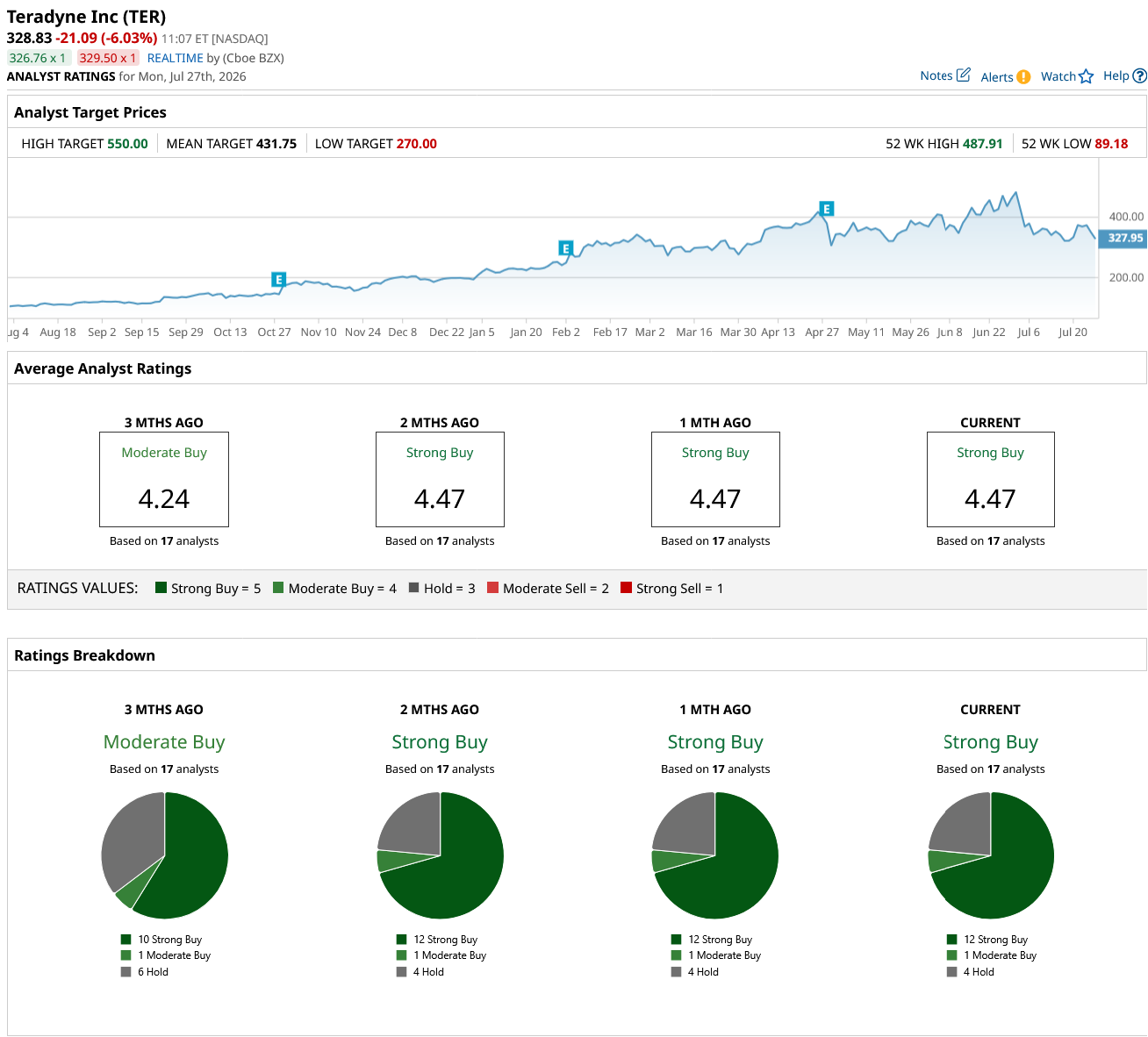
Out of the 17 analysts covering TER stock, 12 recommend “Strong Buy,” one recommends “Moderate Buy,” and four recommend “Hold.” The average TER price target is $431.75, above the current price of about $330.
On the date of publication, Aditya Raghunath did not have (either directly or indirectly) positions in any of the securities mentioned in this article. All information and data in this article is solely for informational purposes. For more information please view the Barchart Disclosure Policy here.