


European Wildfire Stocks Retail Investors May Want To Avoid Right Now
Wildfires sweeping across France and Spain are no longer just a climate story; they are an investment risk filter. When over 300,000 people are forced to evacuate and local economies are disrupted, insurance, infrastructure, and regional asset focused stocks can quickly see pressure from claims, damage, and funding needs. This article looks at how that shock feeds through to listed European companies exposed to the crisis and why some investors may choose to step aside rather than lean in. Ahead, find 3 stocks from this wildfire impact screener that could be negatively affected.
Vinci (ENXTPA:DG)
Overview: Vinci is a French-based global infrastructure group that runs toll roads, airports and other concessions, and also provides energy services and large scale construction and property development across transport, industrial and urban projects.
Operations: Vinci generates most of its revenue from Construction at about €32.1b, followed by Energy Solutions at around €29.6b, with Concessions such as autoroutes and airports contributing roughly €13.1b and smaller items and eliminations making up the rest.
Market Cap: €62.5b
Vinci sits at the heart of roads, airports and public works that could be directly affected by the French wildfires. This raises tough questions about future repair costs and the economics of some long term concessions. The company has healthy operating margins above 10% and an A3 credit rating. However, it is also highly leveraged and operates in a cyclical industry, where a narrow moat leaves less room for error if traffic or project volumes soften. The stock screens as reasonably priced on several models, yet some detailed valuations flag it as at least a little overvalued. For investors worried about climate related stress on infrastructure, this mix of quality and potential overpricing is one reason Vinci may warrant a closer and more cautious look.
Vinci’s solid margins and A3 credit rating may mask how exposed its concessions and construction projects are to wildfire repair costs and softer traffic, so it is worth scanning the 5 key rewards and 2 important warning signs
Mapfre (BME:MAP)
Overview: Mapfre is a Spain based insurer that offers a wide range of life, health, motor, property, agricultural and business policies, alongside reinsurance, investment and pension products for individuals, professionals and companies of all sizes.
Operations: Mapfre generates most of its revenue from Iberia at about €9.9b, Brazil at roughly €5.0b, Other LATAM at about €6.2b and Reinsurance at around €7.9b, with additional contributions from Global Risks at €3.2b, North America at €2.9b, EMEA at €2.0b and smaller assistance and adjustments.
Market Cap: €13.3b
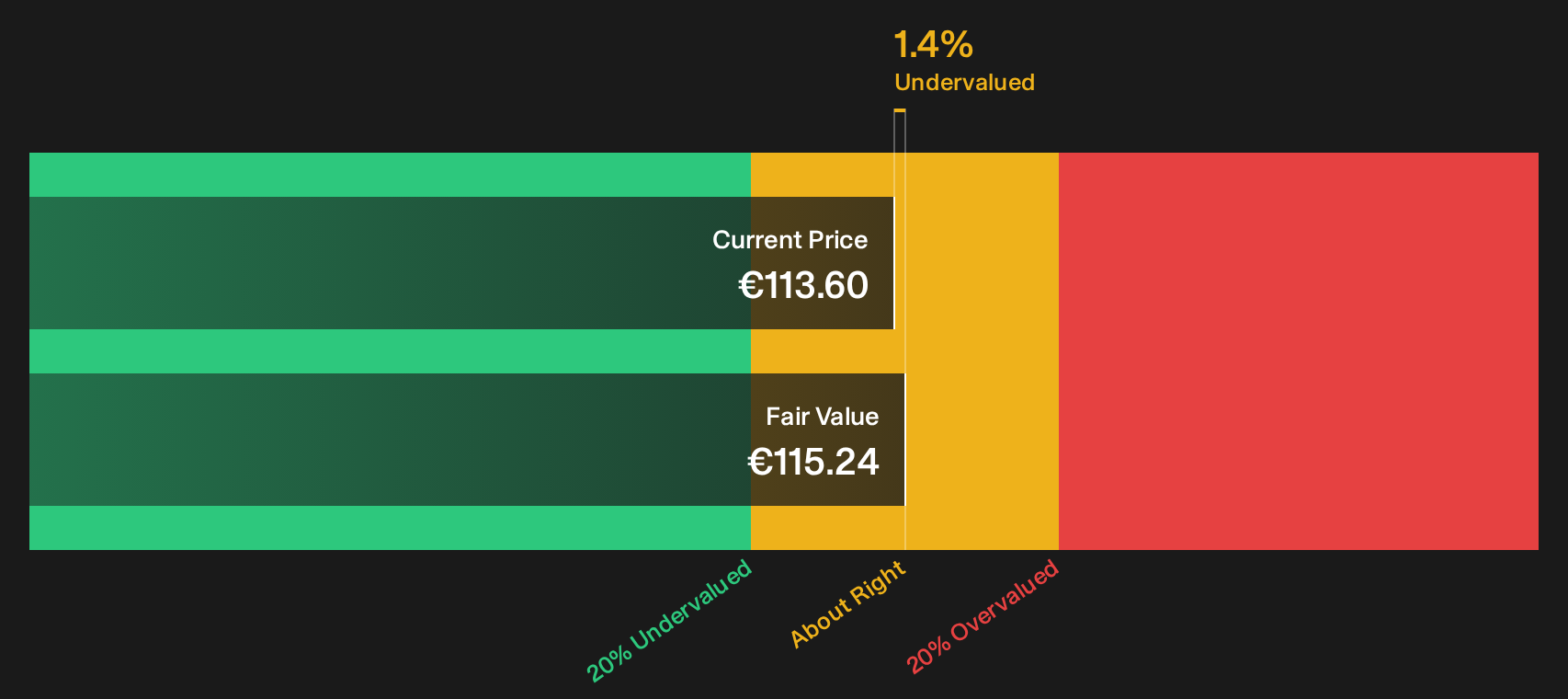
Mapfre looks interesting on paper with a €13.3b market value, a solid dividend yield and earnings support from recent deals like the Safety Insurance acquisition. At the same time, the wildfire crisis in Spain puts a harsh spotlight on its exposure to property, agriculture and rural claims in exactly the regions under stress. Management has highlighted the role of Spain’s insurance compensation consortium in absorbing extreme weather losses, but investors still have to weigh higher catastrophe frequency, pressure on motor and health lines and projected revenue declines against the recent profit momentum and capital strength. For anyone screening for European wildfire impact, the key question is whether Mapfre’s apparent value and resilience are enough to offset the rising cost and volatility of climate related risks.
Mapfre’s dividend and recent deals may be masking how wildfire risk could reshape its core insurance book, so it is worth reviewing the analysis report for Mapfre to identify the next potential impact that consensus might be missing.

AXA (ENXTPA:CS)
Overview: AXA is a global insurance group based in Paris that offers life, health, property and casualty cover, alongside asset management and some banking services, for both individuals and businesses across Europe, Asia, the Americas and emerging markets.
Operations: AXA generates most of its revenue from Europe at about €35.6b, followed by France at around €24.7b, AXA XL at roughly €19.7b, Asia, Africa & EME LATAM at about €13.7b, and Transversal & Other at around €2.6b, with intersegment eliminations of about €1.6b.
Market Cap: €92.1b
AXA is one of Europe’s largest insurers, with global reach and digital tools such as its GenAI chatbot Sophia. Revenue growth forecasts currently outpace those for the broader French market, yet the wildfire crisis in France and Spain highlights its exposure to property, casualty and catastrophe claims. Earnings growth has been modest at 2% over the past year, and net profit margins of 7.7% leave limited room if large claims or softer reinsurance pricing occur. The company also relies entirely on higher risk external borrowing for funding and has an unstable dividend track record, which can matter when volatility rises. For investors focused on climate risk, AXA may appear less like a safe haven and more like a live stress test.
AXA’s wildfire exposure, modest 2% earnings growth and 7.7% net margins could be masking a tougher profitability story ahead, so it is worth reading the 3 key rewards and 1 important warning sign

Take Control of Your Investment Journey
If Vinci or any of these companies are making you feel more cautious, register for FREE with Simply Wall St and add your companies to a Watchlist to monitor the share price against the fair value and track any new developments as they happen. Once you've made your move, manage your holdings with our Portfolio Command Center that filters out the noise to deliver only the most critical, actionable updates. Throughout your journey, our Community allows you to filter the best ideas from thousands of investor perspectives. By uncovering hidden catalysts and risks early, you'll accelerate your decision-making and stay one step ahead of the market.
Seeking Fresh Alternatives Before Others Do
Markets move fast, and the next breakout stories rarely stay under the radar for long. Spot fresh momentum while it matters, before the crowd catches up, and act now.
- Target steadier potential returns and lower volatility by scanning resilient businesses inside the 297 resilient stocks with low risk scores that have been filtered for stronger balance sheets and more controlled risk profiles.
- Ride structural demand for critical materials by reviewing the curated 8 top copper producer stocks powering grids, electrification and energy transition projects before interest really starts flying.
- Hunt for quality at a discount by working through a hand picked 248 high quality undervalued stocks that screens for stronger cash flows and sturdier fundamentals while prices are still dropping or flat.
This article by Simply Wall St is general in nature. We provide commentary based on historical data and analyst forecasts only using an unbiased methodology and our articles are not intended to be financial advice. It does not constitute a recommendation to buy or sell any stock, and does not take account of your objectives, or your financial situation. We aim to bring you long-term focused analysis driven by fundamental data. Note that our analysis may not factor in the latest price-sensitive company announcements or qualitative material. Simply Wall St has no position in any stocks mentioned.
Have feedback on this article? Concerned about the content? Get in touch with us directly. Alternatively, email editorial-team@simplywallst.com