


Allied Properties REIT (TSX:AP.UN) Trims Debt And Keeps Payout, But Does Valuation Hold Up
Allied Properties Real Estate Investment Trust (TSX:AP.UN) recently affirmed a monthly distribution of CA$0.06 per unit for July 2026, a key development as the REIT works to reshape its balance sheet and address office sector pressures.
See our latest analysis for Allied Properties Real Estate Investment Trust.
The recent affirmation of the CA$0.06 monthly distribution comes as Allied Properties Real Estate Investment Trust trades at CA$10.45, with short term momentum showing in a 1 day share price return of 4.29%. However, the 1 year total shareholder return has declined 36.02%, indicating sentiment has weakened over a longer horizon.
If Allied Properties REIT’s recent move has you reassessing where the next opportunity might come from, this could be a good moment to widen your search with the 3 top founder-led companies
So is Allied Properties REIT’s recent price lift and maintained CA$0.06 monthly payout pointing to a business that is steadier than sentiment suggests, or does the weaker long term return indicate that the market is still cautious on value?
Preferred Price-to-Sales Ratio of 3.5x: Is it justified?
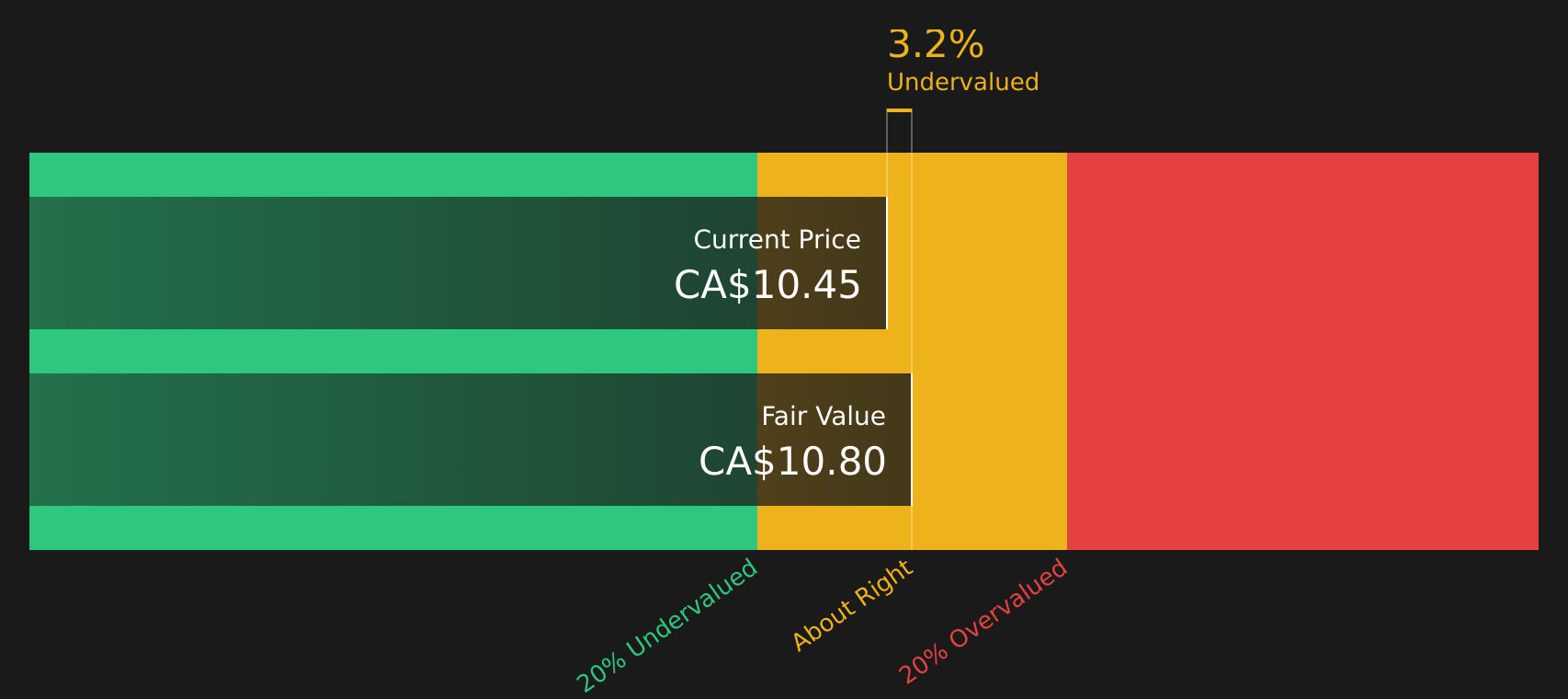
On Simply Wall St's numbers, Allied Properties Real Estate Investment Trust trades at a P/S ratio of 3.5x while the share price sits at CA$10.45, and the stock is described as trading 3.2% below an estimated fair value based on future cash flow assumptions.
The P/S ratio compares the CA$10.45 market price to the revenue the trust generates per unit and is often used for companies where earnings are currently negative. For Allied Properties REIT, this matters because the trust is unprofitable today and reported a loss of CA$1,366.6m on revenue of CA$585.7m, so earnings-based metrics such as P/E are not meaningful.
However, the same dataset flags that Allied Properties REIT looks expensive on this P/S ratio relative to both its peer set at 2.6x and the wider North American Office REITs group at 2.0x. In other words, the market is paying a much higher revenue multiple than the sector averages, while an estimated fair P/S ratio of 1.3x suggests there is a gap between the current valuation level and where the ratio could trend if it moved closer to that fair estimate.
Explore the SWS fair ratio for Allied Properties Real Estate Investment Trust
Result: Price-to-sales ratio of 3.5x (OVERVALUED)
However, Allied Properties Real Estate Investment Trust still faces risks from ongoing losses and a long-term total return that has declined sharply over multiple years.
Find out about the key risks to this Allied Properties Real Estate Investment Trust narrative.
Another View on Allied Properties REIT: What the DCF Says
While the current P/S ratio of 3.5x presents Allied Properties Real Estate Investment Trust as expensive, the SWS DCF model presents a different conclusion, with an estimated fair value of CA$10.80 per unit compared with the current CA$10.45 price, a modest discount of around 3%.
That small gap suggests neither a clear bargain nor an obvious excess. This raises a practical question for investors: is this DCF signal enough to offset concerns around losses, dilution and sector pressure, or is it simply too narrow a margin of safety to rely on?
Look into how the SWS DCF model arrives at its fair value.
Simply Wall St performs a discounted cash flow (DCF) on every stock in the world every day (check out Allied Properties Real Estate Investment Trust for example). We show the entire calculation in full. You can track the result in your watchlist or portfolio and be alerted when this changes, or use our stock screener to discover 5 high quality undervalued stocks. If you save a screener we even alert you when new companies match - so you never miss a potential opportunity.
Next Steps
Given the mixed signals around Allied Properties Real Estate Investment Trust, it makes sense to review the underlying data and form your own stance while sentiment is still divided, starting with the 2 key rewards and 3 important warning signs.
Looking for more investment ideas beyond Allied Properties REIT?
If Allied Properties Real Estate Investment Trust has sharpened your focus on value and income, do not stop here. The broader market still holds plenty of potential opportunities.
- Spot potential turnaround stories with stronger balance sheets by checking out the 13 elite penny stocks with strong financials that already clear key financial quality hurdles.
- Zero in on quality at a price that might suit you by reviewing the 5 high quality undervalued stocks that combine solid fundamentals with discounted valuations.
- Strengthen the defensive side of your portfolio by scanning the 9 resilient stocks with low risk scores that score well on resilience and financial stability.
This article by Simply Wall St is general in nature. We provide commentary based on historical data and analyst forecasts only using an unbiased methodology and our articles are not intended to be financial advice. It does not constitute a recommendation to buy or sell any stock, and does not take account of your objectives, or your financial situation. We aim to bring you long-term focused analysis driven by fundamental data. Note that our analysis may not factor in the latest price-sensitive company announcements or qualitative material. Simply Wall St has no position in any stocks mentioned.
Have feedback on this article? Concerned about the content? Get in touch with us directly. Alternatively, email editorial-team@simplywallst.com