


Dana Gas Stock Stands Out As Iran Inflation Shock Ripples Across Middle East Markets
Iran’s currency shock and hyperinflation, with the rial nearing 2 million per US dollar and consumer prices up about 89% year over year, are not just local headlines; they are reshaping risk and opportunity across the wider Middle East. Energy flows, trade finance, and gas supply routes are all in focus as regional markets adjust to Iran’s instability and the possibility of further disruption. This article walks through three stocks exposed to these developments, highlighting one that could be positioned to benefit and two where the Iran fallout may increase pressure, so you can decide how they fit into your watchlist.
Emirates NBD Bank PJSC (DFM:EMIRATESNBD)
Overview: Emirates NBD Bank PJSC is a major Dubai based bank that provides a full range of services, from everyday current and savings accounts to corporate lending, trade finance, Islamic banking, wealth management, and brokerage across the Middle East and selected international markets.
Operations: Emirates NBD generates its revenue mainly from Retail Banking and Wealth Management (AED 17.4b), Corporate and Institutional Banking (AED 12.9b), DenizBank in Turkey (AED 12.0b), Global Markets and Treasury (AED 2.5b), with smaller contributions from other activities (AED 5.2b) and segment adjustments.
Market Cap: AED 190.9b
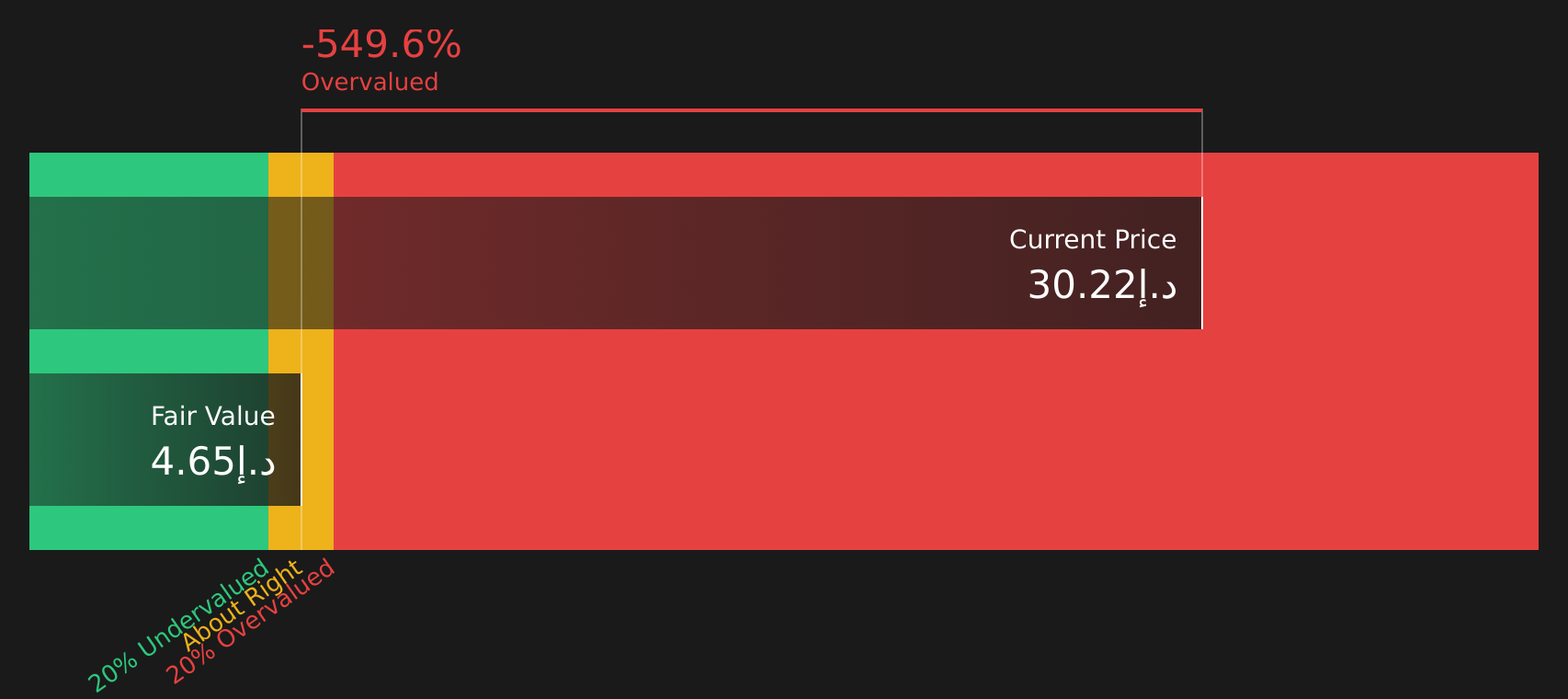
Investors looking at Emirates NBD today are weighing a large, regionally important bank with strong fee and interest income against rising macro risk. The stock trades on a relatively low P/E and has grown earnings over several years. However, asset quality is a concern, with bad loans above the 2% threshold and meaningful exposure to higher risk markets through DenizBank. The Iranian rial crisis and broader regional tension add another layer of uncertainty for funding conditions, cross border credit and trade flows that matter for a bank of this size. At the same time, the current share price already sits well above one cash flow based fair value estimate, so any earnings wobble or further geopolitical stress could leave investors questioning how much downside protection they really have.
Emirates NBD’s low P/E might be masking more credit risk than it seems, especially with bad loans above 2% and exposure to higher risk markets, so it is worth reading the 4 key rewards and 1 important warning sign
Dana Gas PJSC (ADX:DANA)
Overview: Dana Gas PJSC is a Sharjah based natural gas company that explores for, produces, processes, and sells gas and petroleum products across the United Arab Emirates, the Kurdistan region of Iraq, and Egypt, while also developing related infrastructure such as transmission and gas treatment projects.
Operations: Dana Gas generates about US$352 million of revenue from its integrated oil and gas activities, with roughly US$267 million from the Kurdistan region of Iraq, US$81 million from Egypt, and US$4 million from the United Arab Emirates.
Market Cap: AED 6.2b
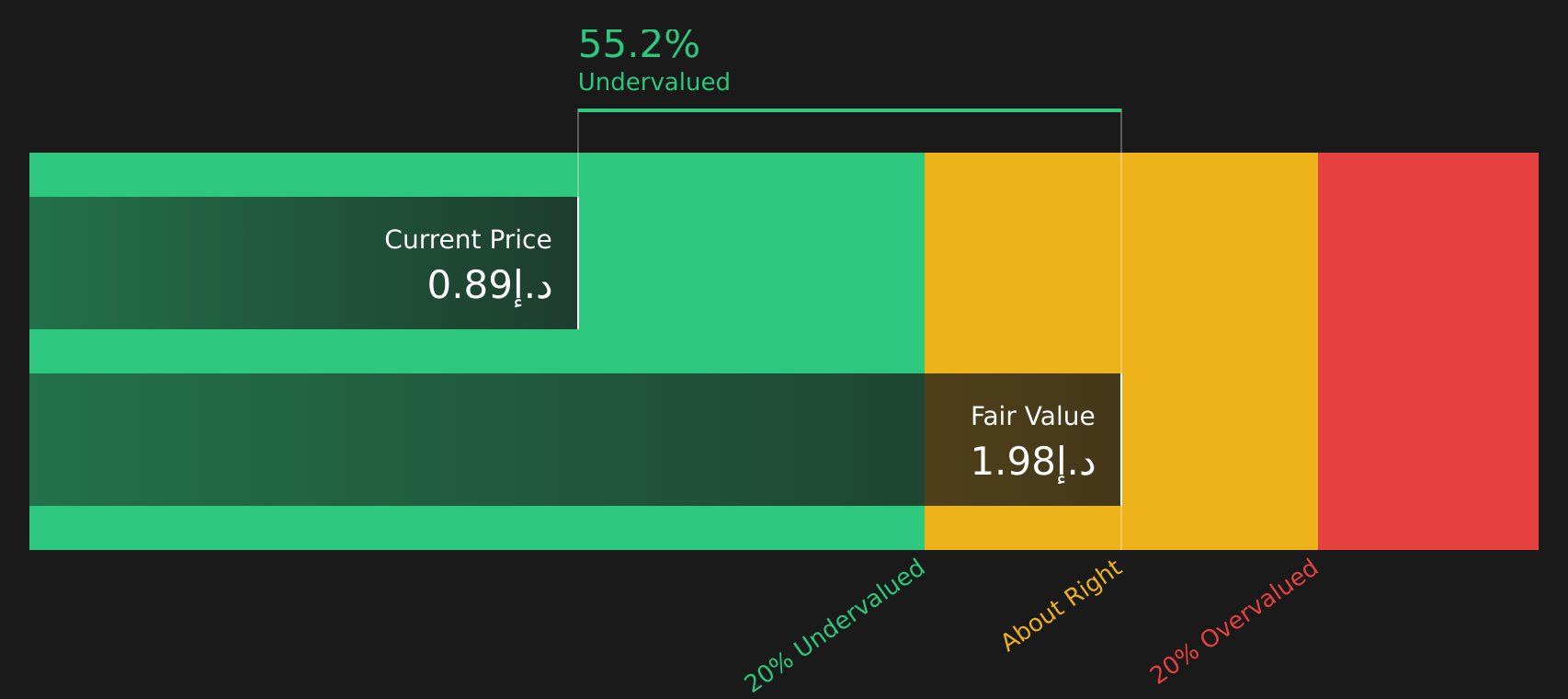
Dana Gas operates at the intersection of tightening regional energy supply and evolving project execution, which is why the Iran inflation shock may be relevant for investors. As a regional gas producer, it could potentially experience changes in demand if Iranian supply is disrupted, alongside volume driven growth from the KM250 expansion, new pipeline capacity in Kurdistan and a reviving Egypt portfolio. The stock appears undervalued against some cash flow estimates, yet it also involves clear trade offs, including reliance on external borrowing, questions over how comfortably its dividend is funded and exposure to government counterparties. For investors who are comfortable with these risks, the combination of recent earnings performance, high margins and a visible portfolio of gas projects may warrant further research into Dana Gas.
Dana Gas looks like a cash flow story that the market has not fully priced in yet, especially with KM250, Kurdistan pipelines and Egypt all in play. It is therefore worth reading the analysis report for Dana Gas PJSC to see what might be quietly driving the risk reward balance next.
Türkiye Petrol Rafinerileri (IBSE:TUPRS)
Overview: Türkiye Petrol Rafinerileri runs large, complex refineries and related energy assets that turn crude oil into fuels and chemical products for Turkey and export markets, while also generating electricity and investing in newer areas such as renewables and electric vehicle charging.
Operations: Türkiye Petrol Rafinerileri generates almost all of its revenue from Refining at about TRY 872.2b, with a smaller Electric segment contributing roughly TRY 8.9b.
Market Cap: TRY 586.2b
Türkiye Petrol Rafinerileri sits at the heart of Turkey’s fuel supply at a time when Iran’s currency and inflation crisis threatens regional trade routes and feedstock costs, which could put pressure on refining margins that analysts already expect to cool from recent strength. The company has scale, complex refineries and growing low carbon projects. However, its earnings outlook is described as only modest against broader market expectations, the dividend is flagged as not well covered by earnings and funding leans on higher risk external borrowing. With the stock trading above one cash flow based fair value estimate and heavily exposed to Middle East disruption, the key question is how much of the positive factors are already reflected in the share price and how resilient profits are if crack spreads or regional flows weaken.
Türkiye Petrol Rafinerileri’s scale and complex refineries might be masking how exposed profits are to regional disruption, external borrowing and a dividend that is not well covered by earnings, so the 2 key rewards and 1 important warning sign

Take Control of Your Investment Journey
If Türkiye Petrol Rafinerileri or any of these companies have caught your attention, register for FREE with Simply Wall St and add your companies to a Watchlist to monitor the share price against the fair value and track any new developments as they happen. Once you've made your move, manage your holdings with our Portfolio Command Center that filters out the noise to deliver only the most critical, actionable updates. Throughout your journey, our Community allows you to filter the best ideas from thousands of investor perspectives. By uncovering hidden catalysts and risks early, you'll accelerate your decision-making and stay one step ahead of the market.
Seeking Alternatives Before Momentum Flies Past?
Fresh stock ideas can move from under the radar to full breakout fast. By the time the crowd catches on, the easy entry points may no longer be available.
- Identify cash-rich companies before momentum builds further by scanning the list of solid balance sheet and fundamentals (418 results), which focuses on resilient fundamentals and cleaner balance sheets.
- Follow capital flowing into automation by reviewing the 34 robotics and automation stocks packed with companies tied to robots, factory upgrades and real-world productivity solutions.
- Explore potential infrastructure-related opportunities by checking the 35 power grid technology and infrastructure stocks, which highlights businesses linked to grid hardware, software and equipment that help keep electricity networks running.
This article by Simply Wall St is general in nature. We provide commentary based on historical data and analyst forecasts only using an unbiased methodology and our articles are not intended to be financial advice. It does not constitute a recommendation to buy or sell any stock, and does not take account of your objectives, or your financial situation. We aim to bring you long-term focused analysis driven by fundamental data. Note that our analysis may not factor in the latest price-sensitive company announcements or qualitative material. Simply Wall St has no position in any stocks mentioned.
Have feedback on this article? Concerned about the content? Get in touch with us directly. Alternatively, email editorial-team@simplywallst.com