


Japan Bank Stocks Investors Are Watching As Rates Rise
Japan’s latest inflation data, with core prices at 1.6% and underlying inflation at 1.7%, has put interest rates and the yen back at the center of the investment conversation. If the Bank of Japan continues to lift rates, some parts of the Japanese financial sector could see their earnings mix change, funding costs reset and balance sheet risks reshaped. This article looks at how that backdrop links to three large financial stocks from our Japanese Financial Sector Stocks screener, all of which appear positively exposed to the current trend, and why they might deserve a closer look or a cautious pause.
Seven Bank (TSE:8410)
Overview: Seven Bank is a Tokyo based bank that runs a large network of ATMs, deposit and loan services, and payment solutions for individuals and companies in Japan and overseas, while also providing identity verification, fraud detection and back office support services.
Operations: Seven Bank generates most of its revenue from domestic banking and related services in Japan at ¥144,021m, with additional contributions from credit card and electronic money at ¥30,664m and foreign operations at ¥42,941m, largely tied to customers in Japan at ¥176,426m and the USA at ¥27,282m.
Market Cap: ¥362.8b
Seven Bank is positioned as a pure play on everyday banking activity at a time when Japanese interest rates are in focus. The stock currently trades below an internal estimate of its future cash flow value, yet carries a relatively high P/E and a dividend yield of 3.54% that is not clearly backed by earnings, which raises questions about sustainability. Recent one off losses, weaker margins and past shareholder dilution indicate that this is not a simple income story, and investors who look deeper will find a more complex mix of potential upside and real trade offs.
Seven Bank’s mix of a high P/E, a 3.54% yield and recent one off losses suggests something important is hiding in plain sight. The 2 key rewards and 3 important warning signs could show whether the current payout is a bridge or a warning sign.

Gunma Bank (TSE:8334)
Overview: Gunma Bank is a regional lender based in Maebashi that offers a full suite of banking services for individuals and businesses, from deposits and loans to foreign exchange, investment products, pensions and trust and inheritance support, along with leasing and insurance agency services.
Operations: Gunma Bank generates most of its revenue from banking at ¥163,234m, with leasing contributing ¥34,810m, other activities ¥9,546m and a small unallocated adjustment of ¥3,631m, all primarily tied to customers in Japan at ¥195,494m.
Market Cap: ¥987.5b
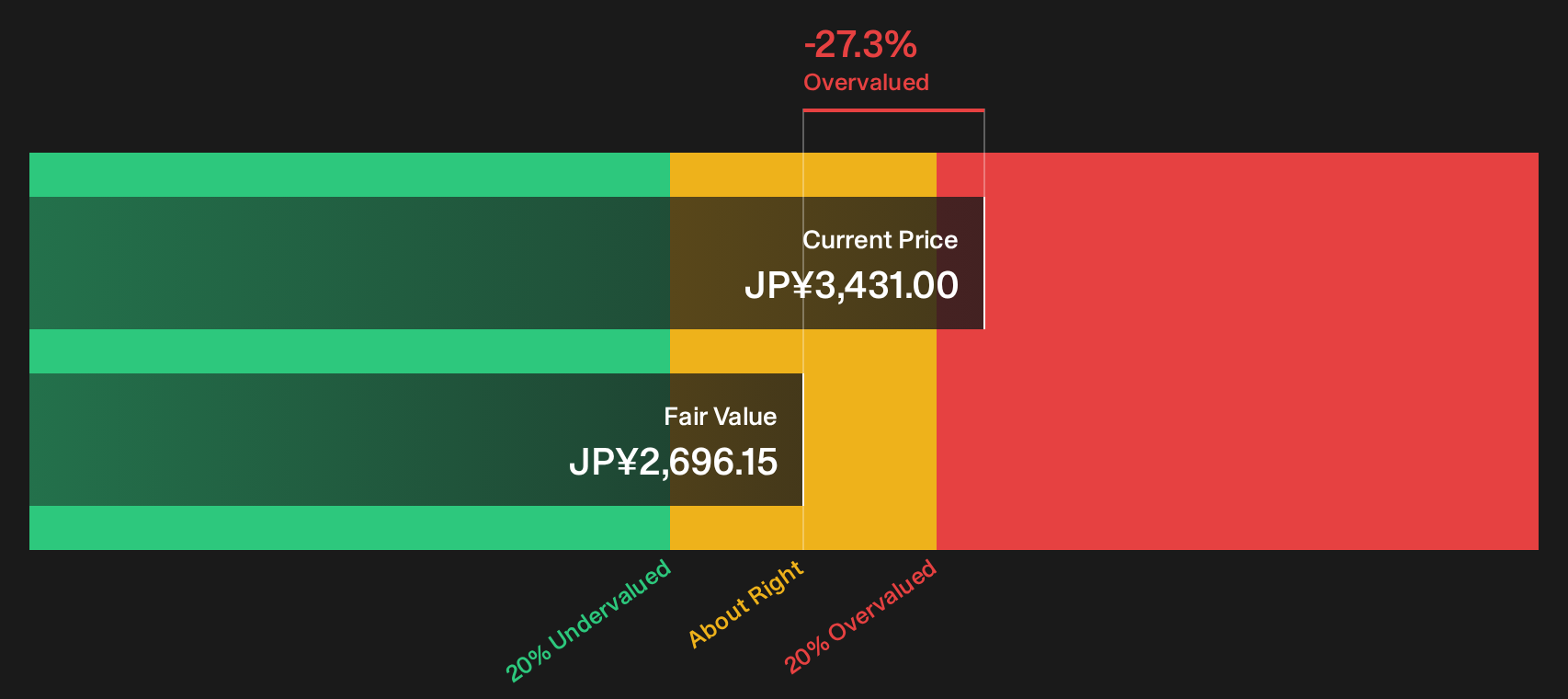
Gunma Bank sits at the center of the interest rate story in Japan, with higher rates directly feeding into net interest income and net profit margins that currently stand at 30.1%. Dividend payouts have been stepped up and the yield sits at 2.68%. At the same time, the stock trades above an internal cash flow estimate and carries a P/E that is slightly higher than the Japanese banks average, and board independence is limited at 40%.
Gunma Bank’s rising net interest income and 30.1% margin could be masking a very different story once you stack its valuation premium and payout against peers, and the 3 key rewards and 1 important warning sign might reveal the twist investors are missing

Yamaguchi Financial Group (TSE:8418)
Overview: Yamaguchi Financial Group is a regional financial group based in Shimonoseki that runs a core banking business alongside securities brokerage, credit card and leasing services, as well as consulting, insurance agency, credit guarantees and collection services. It also extends into agriculture and crowdfunding, and trades agricultural, forestry and fishery products, tying its financial services closely to local economies.
Operations: Yamaguchi Financial Group generates all of its ¥213,335m in revenue from its Banking Business in Japan.
Market Cap: ¥635.6b
For investors watching how higher interest rates filter through Japan’s regional lenders, Yamaguchi Financial Group offers an example of a bank with both rate sensitivity and regional growth plans. The stock pays a 3.08% dividend. Margins have eased from 20.1% to 15.5%, and return on equity sits at 5%, below a 20% hurdle. The company also trades on an above average P/E, with a share price above some fair value estimates and ongoing questions around provisioning levels, which introduces additional complexity to the investment case. Recent buybacks and a push into “regional co creation” efforts indicate that management is pursuing strategies aimed at unlocking additional value beyond what current forecasts may imply.
Yamaguchi Financial Group’s push into regional co creation, paired with its 3.08% dividend and buybacks, could be masking a far bigger story than the headline P/E suggests, and the 2 key rewards and 1 important warning sign may be where the real trade off shows up
The stocks covered here are only a starting point, and the full Japanese Financial Sector Stocks screener has surfaced 17 more companies with equally compelling narratives that tie into the rate, dividend and balance sheet themes discussed so far through the Japanese Financial Sector Stocks screener. Identify and analyze the specific catalysts, risks and storylines that matter most to you by using Simply Wall St to filter for factors such as earnings quality, capital return policies and interest rate sensitivity so you can focus on your highest conviction ideas.
Take Control of Your Investment Journey
If Gunma Bank or any of these companies sound like a great opportunity, register for FREE with Simply Wall St and add your companies to a Watchlist to monitor the share price against the fair value the ideal entry point. Once you've made your move, manage your holdings with our Portfolio Command Center that filters out the noise to deliver only the most critical, actionable updates. Throughout your journey, our Community allows you to filter the best ideas from thousands of investor perspectives. By uncovering hidden catalysts and risks early, you'll accelerate your decision-making and stay one step ahead of the market.
Seeking Fresh Alternatives Beyond Japanese Banks?
Markets move fast and the next breakout ideas rarely stay under the radar for long. Scan fresh momentum, catch trends while it matters and get in early.
- Spot cash rich companies before momentum is fully priced in by running the 17 high quality undervalued stocks that filters for quality businesses still trading at compressed valuations.
- Track future facing infrastructure plays with real revenue by scanning the 55 AI infrastructure stocks that highlights businesses building the backbone for expanding AI demand.
- Target resilient price setters in critical materials using the 8 top copper producer stocks that focuses on producers with meaningful scale in this essential commodity supply chain.
This article by Simply Wall St is general in nature. We provide commentary based on historical data and analyst forecasts only using an unbiased methodology and our articles are not intended to be financial advice. It does not constitute a recommendation to buy or sell any stock, and does not take account of your objectives, or your financial situation. We aim to bring you long-term focused analysis driven by fundamental data. Note that our analysis may not factor in the latest price-sensitive company announcements or qualitative material. Simply Wall St has no position in any stocks mentioned.
Have feedback on this article? Concerned about the content? Get in touch with us directly. Alternatively, email editorial-team@simplywallst.com