


Oracle (ORCL) Stock Could Look Reasonable Despite Fresh Japan Cloud News
Oracle stock has fallen sharply over the past year, yet on most valuation checks it still screens as attractively priced. This raises the question of whether recent weakness is giving investors a cheaper entry point or reflecting concerns that are not fully captured in the current multiples.
- Over the past 5 years, Oracle has returned about 54.8%, which suggests that long term holders have still seen solid gains despite the recent pullback.
- On the upside, potential growth in Oracle's cloud and AI related contracts, such as secure government and sector specific workloads, can support higher earnings, while heavy capital spending needs and balance sheet pressure are key risks for how much value ultimately reaches shareholders.
- With a high value score of 5 out of 6, the broader set of checks leans toward Oracle looking cheaper than many peers on traditional valuation measures.
The issue now is whether that supportive valuation profile is enough to offset the recent share price declines and the risks tied to Oracle's investment heavy push into cloud and AI infrastructure.
Find out why Oracle's -46.0% return over the last year is lagging behind its peers.
Does Oracle Look Undervalued on Earnings?
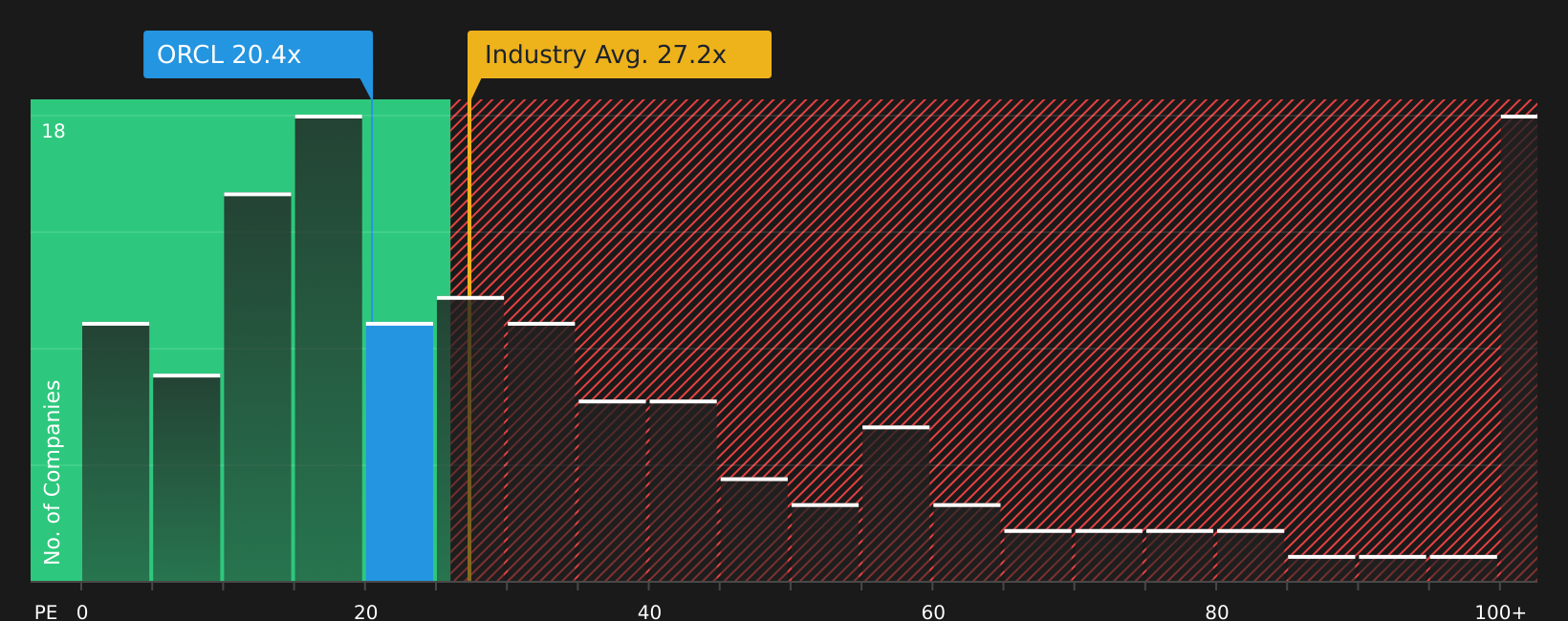
The P/E ratio suits Oracle because earnings remain a key yardstick for mature software companies that already generate meaningful profit. Oracle currently trades on a P/E of 21.5x, compared with about 27.8x for the wider software industry and 39.7x for its closest peer group, so the stock sits at a sizeable discount to both benchmarks.
The fair P/E that falls out of the broader model is 54.0x, which reflects what investors might expect to pay given Oracle’s mix of growth opportunities, margins, size and balance sheet risks. That is well above the current 21.5x, so on this framework the market is not assigning a premium multiple despite the attention around Oracle’s cloud and AI exposure. Because the P/E screens well below both the tailored fair ratio and peer averages, Oracle stock appears undervalued on earnings.
On the P/E multiple, Oracle currently appears undervalued compared with both its fair value benchmark and software peers.
See what the numbers say about this price — find out in our valuation breakdown.
The Oracle Narrative: What Would Justify Today's Price?
Simply Wall St Narratives take this valuation puzzle around Oracle and spell out which paths for the company’s growth, margins and earnings would need to play out for the stock to be worth meaningfully more or less than today’s price, using scenarios that sit on Simply Wall St’s Community page. Each one links its number to a clear view on how Oracle's growth, profitability and risks could evolve, giving you a reference point you can revisit as new data arrives.
Oracle’s community views sit a long way apart, with one narrative framing the stock as deeply mispriced and the other as already full.
Bull case: 67% undervalued
"Oracle’s story is one of a rapid, aggressive transition from enterprise stalwart to AI infrastructure leader, where the OpenAI partnership validated the underlying technology…"
Read the full Bull Case to see why Oracle could be undervalued
Bear case: 6% overvalued
"Instead of competing for entirely new customers, Oracle can migrate existing ones to its own cloud platform…"
Read the full Bear Case to see why Oracle could be overvalued
Do you think there's more to the story for Oracle? Head over to our Community to see what others are saying!
The Bottom Line
Oracle screens as undervalued on its P/E relative to both peers and the tailored fair multiple, and that aligns with the strong overall value checks. For you, the question is whether the current discount is compensation for the heavy cloud and AI investment load or an opening if those projects translate into durable earnings over time. The crux of the bull versus bear debate is whether Oracle can convert its cloud and AI positioning into profitable growth without eroding returns through ongoing capital intensity and balance sheet pressure.
This article by Simply Wall St is general in nature. We provide commentary based on historical data and analyst forecasts only using an unbiased methodology and our articles are not intended to be financial advice. It does not constitute a recommendation to buy or sell any stock, and does not take account of your objectives, or your financial situation. We aim to bring you long-term focused analysis driven by fundamental data. Note that our analysis may not factor in the latest price-sensitive company announcements or qualitative material. Simply Wall St has no position in any stocks mentioned.
Have feedback on this article? Concerned about the content? Get in touch with us directly. Alternatively, email editorial-team@simplywallst.com