


Nvidia (NVDA) Stock Looks Reasonable On Earnings While Cash Flow Stays Key
NVIDIA stock has posted a very large 5 year return, yet the current valuation checks flag a more nuanced picture where both the Discounted Cash Flow (DCF) intrinsic value estimate and earnings multiples suggest the shares may still sit below intrinsic value even after that run.
- A roughly 9.6x gain over 5 years highlights how strongly NVIDIA has rewarded long term holders. This raises the bar for what counts as attractive value today.
- Ongoing AI infrastructure deals, such as expanded partnerships in Japan, can support expectations for future cash flows. At the same time, rising competition in AI chips and custom silicon from large customers may limit how much investors are willing to pay for those prospects.
- NVIDIA scores 4 out of 6 on the valuation checks, which points to a mixed picture rather than a clear bargain or clear overvaluation, even though both the intrinsic value estimate and market multiples currently screen as undervalued.
The issue now is whether that combination of very strong past returns and an apparent undervaluation signal from both the DCF and the multiples still leaves enough potential upside to compensate for the risks around NVIDIA's future cash flows.
Find out why NVIDIA's 18.8% return over the last year is lagging behind its peers.
Is NVIDIA Still Cheap on Cash Flow?
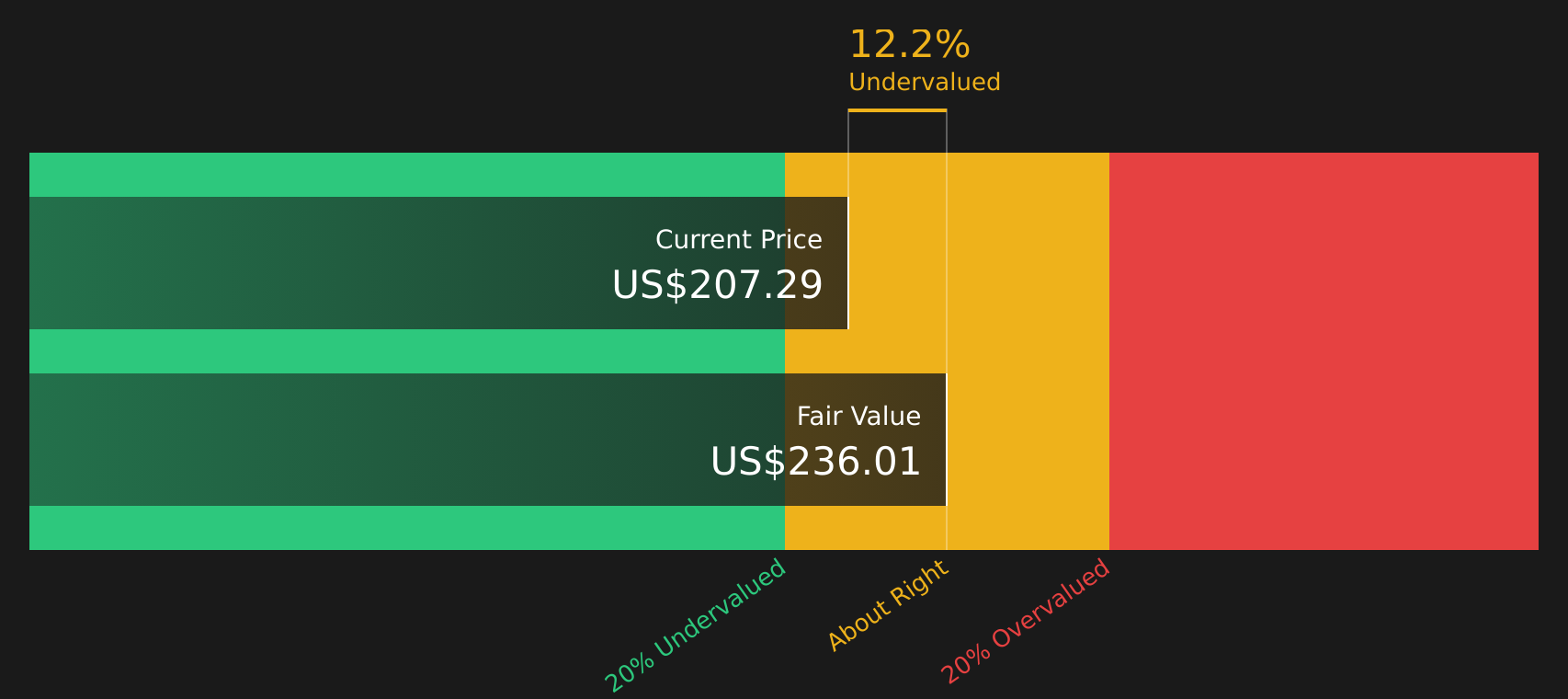
The Discounted Cash Flow (DCF) model estimates what NVIDIA is worth today based on projected cash the business could generate for shareholders. NVIDIA currently reports trailing twelve month free cash flow of about $119.4b, and the model assumes that these cash flows continue growing rather than shrinking, which is reflected in higher projected future free cash flows over time.
On these assumptions, the DCF points to an intrinsic value of about $236 per share, which is 13.9% above the current share price, so the stock screens as undervalued on this method. Nvidia’s AI and robotics expansion in Japan, including large GPU and CPU supply commitments and multiple industrial partnerships, is one factor used to explain why the cash flow expectations embedded in the DCF remain robust even as the share price has been volatile.
On balance, the Discounted Cash Flow model suggests NVIDIA stock currently looks undervalued relative to the cash flows analysts expect it to produce.
Our Discounted Cash Flow (DCF) analysis suggests NVIDIA is undervalued by 13.9%. Track this in your watchlist or portfolio, or discover 45 more high quality undervalued stocks.
Is NVIDIA a Bargain on Earnings?
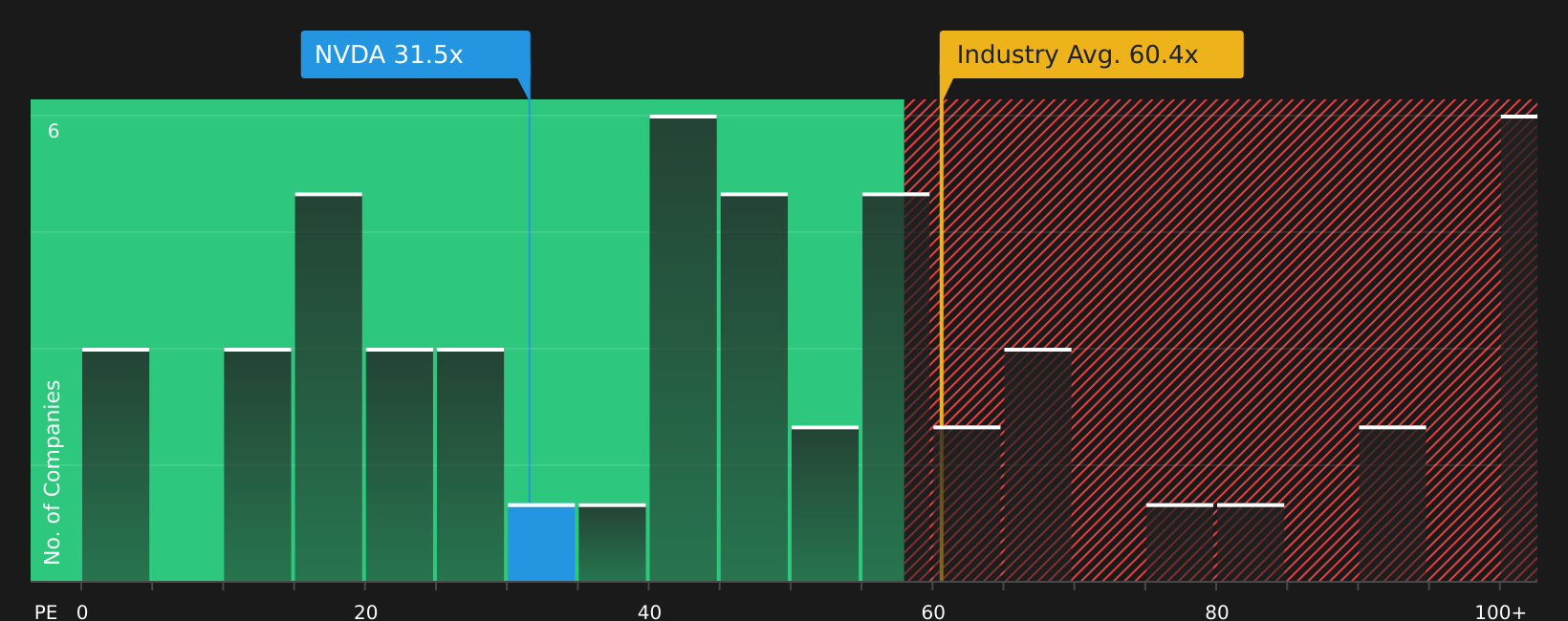
The P/E ratio is a useful yardstick for NVIDIA because earnings have become a central focus for how investors judge the AI hardware leaders.
NVIDIA currently trades at about 30.8x P/E, which sits below the semiconductor industry average of roughly 57.6x and the peer group average of about 78.7x. On Simply Wall St’s tailored fair P/E estimate of 65.3x, which factors in NVIDIA’s growth, margins, size and risk profile, the current multiple is less than half of what the model suggests could be justified.
That gap indicates the market is pricing NVIDIA at a discount to what these earnings-based checks would suggest, based on the performance the stock has already delivered for long term holders.
On this earnings multiple yardstick, NVIDIA stock appears undervalued compared with both its sector and the model’s fair P/E estimate.
See what the numbers say about this price — find out in our valuation breakdown.
The NVIDIA Narrative: What Would Justify Today's Price?
Simply Wall St Narratives pick up where NVIDIA's valuation puzzle leaves off by spelling out which paths for NVIDIA's growth, margins and earnings would need to play out for the stock to be worth materially more or materially less than its current price on the Community page. Instead of stopping at a single output from a ratio or model, they describe the future that number assumes so you can watch how real world developments line up with those expectations over time.
The community is split on NVIDIA, with one side projecting a long runway for AI infrastructure and the other arguing expectations already look stretched.
Bull case: 40% undervalued
"Nvidia will hit $400b annual revenue in 5 years time, ~90% of revenue will come from data centre customers…"
Read the full Bull Case to see why NVIDIA could be undervalued
Bear case: 95% overvalued
"Current valuations price in perpetual hyper-growth, If training stalls and inference diversifies, NVDA could lose its “legendary” aura and re-rate back to more normal multiples…"
Read the full Bear Case to see why NVIDIA could be overvalued
Do you think there's more to the story for NVIDIA? Head over to our Community to see what others are saying!
The Bottom Line
NVIDIA screens as undervalued on both the Discounted Cash Flow (DCF) intrinsic value estimate and current earnings multiples, even after a very strong 5 year return. That combination suggests the market is still applying a discount to the cash flow and earnings profile implied by recent AI driven expectations, rather than fully pricing them in. From here, the key question is whether NVIDIA can sustain the level of cash generation and earnings power that underpins those models, in the face of rising competition and potentially changing demand patterns for AI hardware.
This article by Simply Wall St is general in nature. We provide commentary based on historical data and analyst forecasts only using an unbiased methodology and our articles are not intended to be financial advice. It does not constitute a recommendation to buy or sell any stock, and does not take account of your objectives, or your financial situation. We aim to bring you long-term focused analysis driven by fundamental data. Note that our analysis may not factor in the latest price-sensitive company announcements or qualitative material. Simply Wall St has no position in any stocks mentioned.
Have feedback on this article? Concerned about the content? Get in touch with us directly. Alternatively, email editorial-team@simplywallst.com