


A $5 Billion Reason to Buy UnitedHealth Stock Here
UnitedHealth Group (UNH) is signaling renewed confidence in its future, and investors are taking notice. Alongside a much stronger-than-expected second-quarter earnings report, the healthcare giant announced it now expects to repurchase at least $5 billion of its own shares in 2026, boosting its initial buyback target. Management had already repurchased $4 billion of its common stock through mid-July.
The expanded repurchase program reflects management’s confidence that its turnaround efforts are gaining traction after a challenging 2025 marked by elevated medical costs and regulatory headwinds.
The buyback announcement comes at a pivotal time. UnitedHealth not only beat Wall Street’s earnings expectations but also raised its full-year adjusted earnings guidance as medical cost trends improved and operating performance strengthened across both UnitedHealthcare and Optum. Share repurchases reduce the number of shares outstanding, boosting earnings per share over time while signaling that management believes the stock remains an attractive investment.
Combined with improving profitability, disciplined cost management, and stronger cash generation, the $5 billion buyback provides another compelling reason for long-term investors to take a fresh look at UnitedHealth stock.
About UnitedHealth Stock
UnitedHealth Group is one of the world’s largest healthcare and health insurance companies, providing employer-sponsored and government-sponsored health plans through UnitedHealthcare, while delivering healthcare services, pharmacy benefits, analytics, and technology solutions through its Optum division. The company serves millions of consumers, healthcare providers, employers, and government agencies across the United States. Headquartered in Minnetonka, Minnesota, UnitedHealth has a market cap of $386.95 billion, making it one of the largest companies in the healthcare sector.
UnitedHealth stock has staged an impressive recovery in 2026, reflecting renewed investor confidence following stronger-than-expected financial results and improving medical cost trends. The shares have gained 49.6% over the past 52 weeks and are up 28.1% year-to-date (YTD), significantly outperforming the broader market after rebounding from last year’s sharp selloff.
Momentum accelerated following the company’s second-quarter earnings release on July 16, when UNH surged to $461.62, its highest level in a year, after reporting a strong earnings beat, raising its full-year guidance, and announcing plans to repurchase at least $5 billion of stock. Although the shares pared some of their gains by the close, the sharp rally underscored improving investor sentiment toward the healthcare giant’s turnaround story.
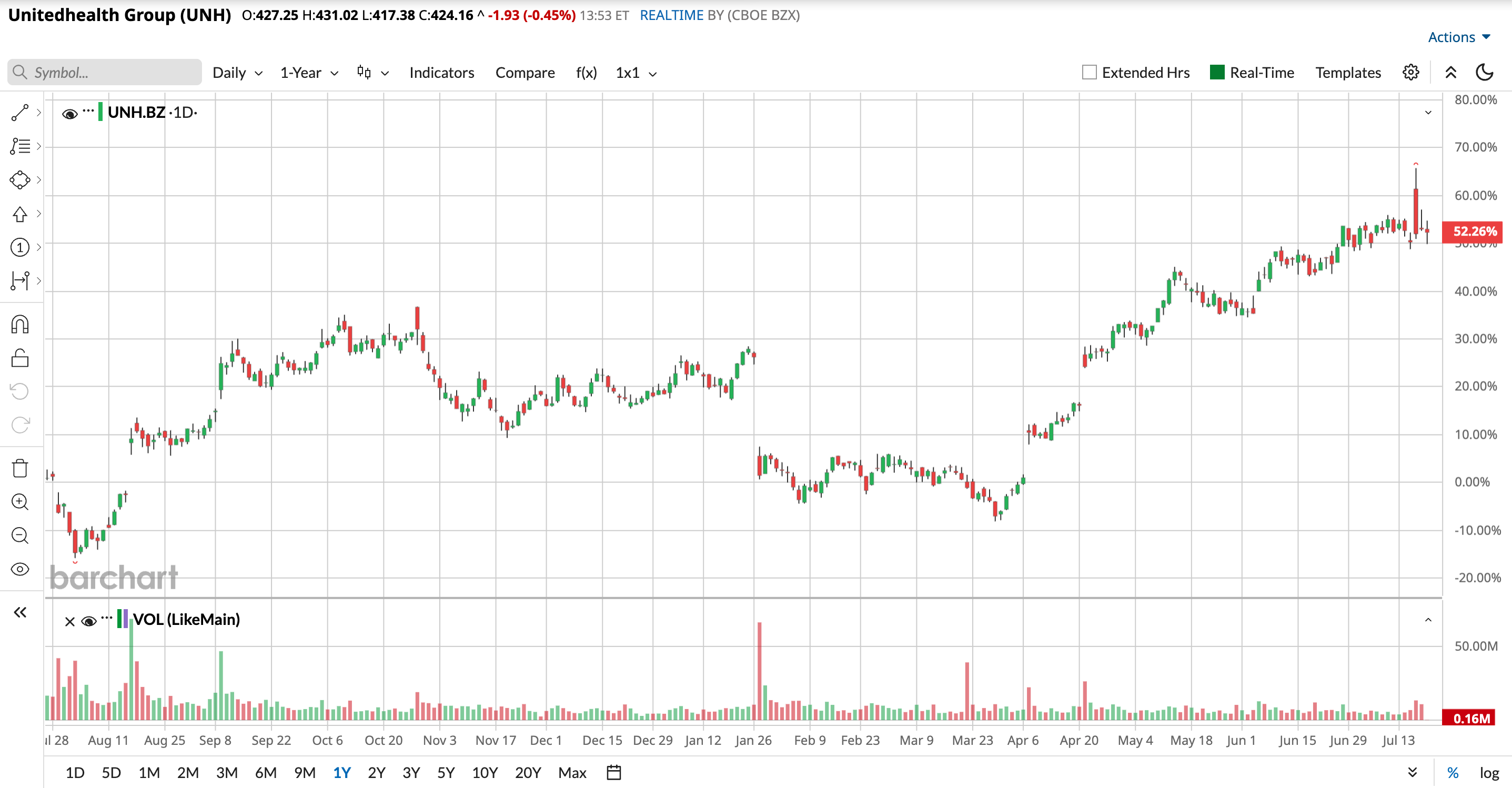
The stock currently trades at 21.44 times forward price-to-earnings, which is higher than the sector median of 19.42 times.
Solid Q2 Performance
UnitedHealth Group reported strong second-quarter 2026 results on July 16, comfortably beating Wall Street expectations and signaling that its turnaround strategy is gaining traction.
The healthcare giant generated revenue of $112 billion, up modestly from $111.6 billion in the year-ago quarter. Earnings from operations surged to $8 billion, a 53.8% year-over-year (YOY) increase from $5.2 billion, while net income climbed 60.7% to $5.5 billion, or $6.04 per share, from $3.4 billion, or $3.74 per share, a year earlier. Adjusted earnings per share rose to $6.38 from $4.08 in the prior-year period, driven by improved medical cost management, pricing discipline, and stronger execution across both UnitedHealthcare and Optum.
The company’s medical care ratio improved to 86.7% from 89.4% a year earlier, reflecting lower healthcare utilization and better cost controls, while operating cash flow nearly doubled to $11.1 billion. Optum’s operating income increased to $4 billion from $3.1 billion, supported by margin expansion and operational improvements.
Reflecting its stronger first-half performance, UnitedHealth raised its full-year 2026 outlook. The company now expects adjusted EPS of $19.50 to $20.00, up from its previous forecast of more than $18.25 per share. It expects a full-year medical care ratio of around 88.1% plus or minus 25 basis points, and operating cash flow of $24 billion.
Analysts predict EPS to be $18.77 for fiscal 2026, a 14.8% increase compared to the prior year, and to rise 12.1% to $21.04 in fiscal 2027.
What Do Analysts Expect for UnitedHealth Stock?
UBS raised its price target on UnitedHealth Group recently to $490 from $460 while reiterating its “Buy” rating after the company’s stronger-than-expected second-quarter results and improving trends in its Medicare Advantage (MA) business.
Also, earlier this month, KeyBanc maintained its “Overweight” rating on UnitedHealth while raising its price target to $475 from $400, while Truist Securities reiterated its “Buy” rating and raised its price target to $480 from $440.
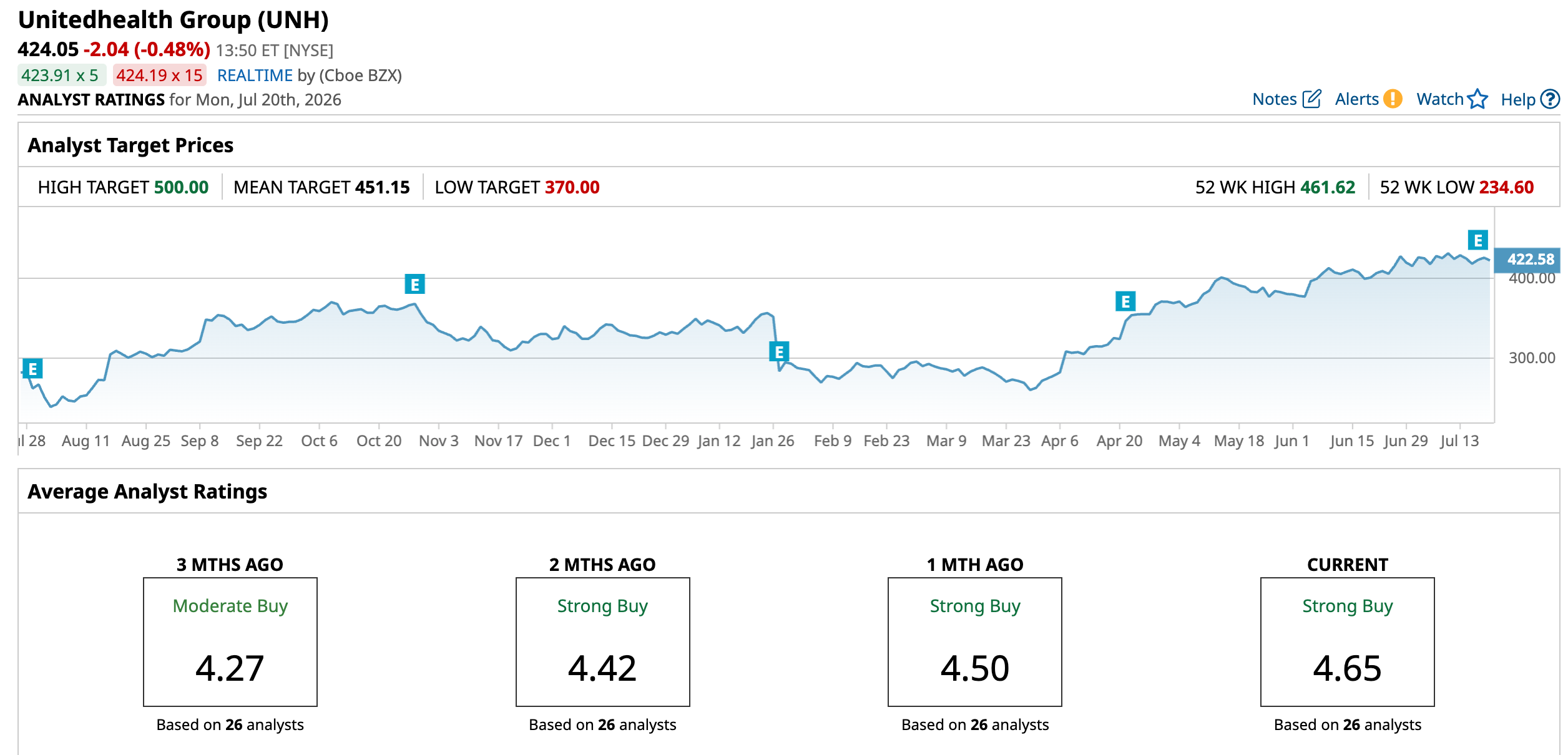
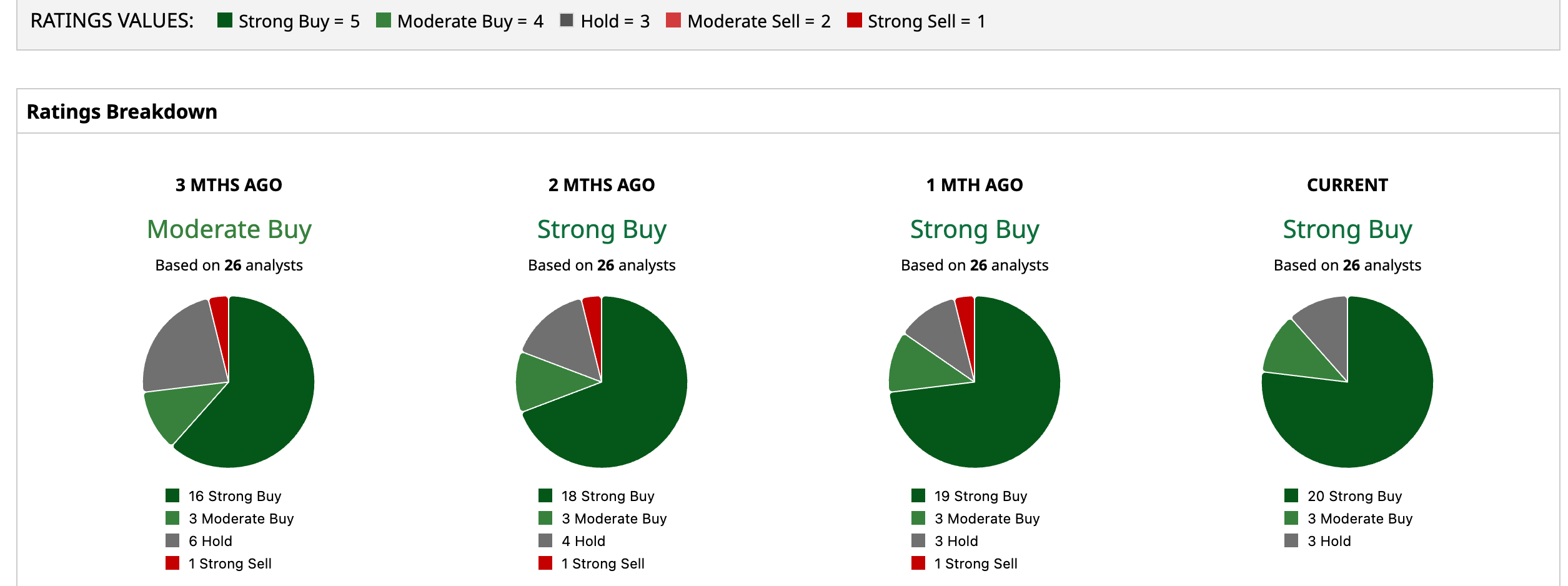
UNH stock has a consensus “Strong Buy” rating overall. Out of the 26 analysts covering the stock, 20 recommend a “Strong Buy,” three advise a “Moderate Buy,” and three suggest a “Hold.”
UNH’s average analyst price target of $451.15 indicates a 6.4% upside potential, while the Street-high target price of $500 suggests 17.9% upside ahead.
On the date of publication, Subhasree Kar did not have (either directly or indirectly) positions in any of the securities mentioned in this article. All information and data in this article is solely for informational purposes. For more information please view the Barchart Disclosure Policy here.