


5% Bond Returns Are a Gift for Retirement Investors. My Favorite Way to Invest in Treasurys Lets You Earn a Paycheck No Matter What the Market Does.
I have been in the investing business long enough to look at today’s fixed-income landscape and see an absolute gift. After more than a decade of being starved for yield by the Federal Reserve, the bond market is finally offering us a clean, honest 5% return on zero-risk U.S. government debt.
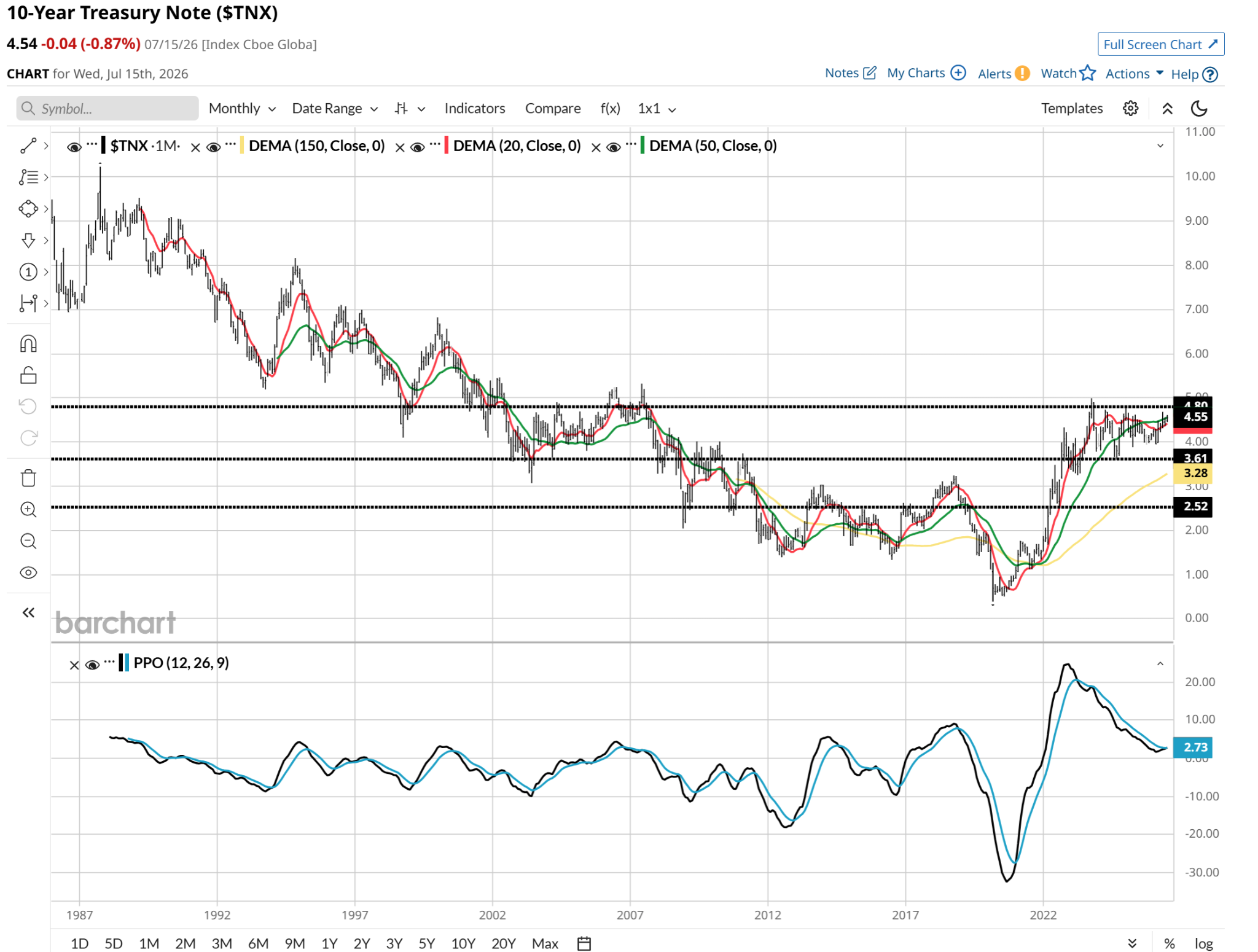
That chart above shows the history of the U.S. 10-Year Treasury bond ($TNX), all the way back to my rookie year in the business (1986). Frankly, the investing world and the world in general were so different back then. The stock market hadn’t yet crashed 22% in a single day (1987), Japan was barely beyond “emerging market” status, and the New York Mets were really good.
Still I did not appreciate just how good bond investors had it back then. They didn’t either, since rates had been in the 10% range or higher for a while, following the 1970s, a decade in which rates peaked in the high teens.
The difference today: I suspect stock market returns are in the process of peaking in that same 15%+ annualized range right now.
I frankly had no idea bonds touched 10% early in my career. But inflation was high to match, so I assume that it was just par for the course.
My attraction to bonds, when the 10-year is at 4.5% and the longest bonds are around 5% or so, is not so much about the real return. I do not know if inflation will kick much higher. In fact, that chart above provides at least a hint that if we see 5% on the 10-year, we could be opening the door to much higher rates.
But let’s take things one step at a time here. Because as I see it, I have bond rates exactly where I want them. The current macro setup gives us a beautifully defined win-win-win scenario if you deploy the right tools.
You can lock in a baseline 5% yield, maintain a tactical hedge to protect you if inflation forces interest rates even higher, or position yourself for a massive capital gains windfall if the economy suddenly cracks and interest rates dive. And to me, my bond ladder (of zero-coupon U.S. Treasuries) is simply a base layer on a portfolio that includes ETFs and trading accounts.
Part of that trading is to “overlay” the bond ladder with ETF and/or option positions that can profit while the long-term bonds are losing money on paper. Yet with bonds we own directly, not through ETFs or mutual funds, we know exactly what we are getting and when. That’s very liberating.
For pre-retirees and baby boomers like me, a sensible move to consider is to lock in this gift by building a high-yield Treasury ladder. But the real magic happens when you don’t just sit on that ladder — you actively work alongside it using a modern ETF toolset to boost the returns of both your fixed income and your non-ladder assets.
To understand why 5% is a helpful base return for me, check that first chart again. For nearly this entire century, 5% has been a solid annual return. And if this market bubble ends like the last several did, we’ll have an extended period where 5% a year will not only look great versus equity returns, it might also save your retirement.
For my personal portfolio, I have constructed a comprehensive zero-coupon Treasury bond ladder designed to pay out a massive, guaranteed annual paycheck every single year from 2030 all the way through 2049, covering my personal horizon from age 66 to age 85. I have and will adjust it as market conditions change. But the core ladder is in place. Like an annuity, but I control the ship.
I’m 62, so this also creates a very gradual financial planning process, whereby I know some core parts of my retirement plan are set. The wildcards are things like how much I work, how much I make while working, and how much risk I take in the rest of my portfolio. The key is that I am DIY-ing my way through it, but with way less pressure to have the stock market determine my destiny.
With that baseline completely secured, the rest of my portfolio becomes a flexible, “go-anywhere” vehicle designed to grow in a strictly risk-managed way. Here is how that blueprint handles any directional macro wave the market throws at us next:
- Scenario A: Rates Hold Flat. If sticky inflation keeps the Federal Reserve frozen, your ladder does exactly what it was built to do. It quietly compounds your principal at a reliable 5% clip, completely insulated from the volatile overnight air pockets currently hitting expensive tech stocks.
- Scenario B: Rates Dive. If corporate spending cannibalization continues to fracture the technology sector and the economy slides into a sharp recession, the Fed will be forced to aggressively slash interest rates. Because bond prices move in the opposite direction of yields, a sudden plunge in rates will trigger an immediate, massive capital gains windfall on your long-dated Treasury bonds.
- Scenario C: Rates Surge. If unexpected global supply shocks or geopolitical escalations drag interest rates even higher, your long-term bonds will face temporary price pressure. To neutralize this risk, you simply deploy tactical, short-term inverse ETFs (like the ProShares Short 20+ Year Treasury ETF (TBF) or the Direxion Daily 20 Year Treasury Bear 3X ETF (TMV)) alongside your ladder. These inverse tools generate positive cash flow as interest rates rise, successfully shielding your principal from downside volatility. iShares 20+ Year Treasury Bond ETF (TLT) put options are also a consideration.
The Big Mistake to Avoid If You Are Age 50 or Older
The biggest mistake retail investors make in a 5% environment is adopting a purely passive, “set-it-and-forget-it” mindset. Sitting entirely in cash or basic bond funds leaves massive amounts of money on the table.
A more modern, sophisticated approach is to treat your Treasury ladder as your portfolio’s anchor, and then use nimble, rules-based ETF pairings to actively boost your total return.
Wall Street’s mainstream marketing machine loves to prod retirees into complex, unhedged dividend-chasing schemes that silently expose their hard-earned principal to catastrophic single-stock equity crashes. Don’t fall into that trap.
The U.S. government is actively handing us a 5% baseline risk-free return. Take a good, hard look at that gift, research building your ladder, and then flavor the rest of your portfolio with whatever ETFs, stocks, options, and other investments you wish. That’s my way to use these historic bond market conditions to intelligently out-navigate the Wall Street casino.
Rob Isbitts is a semi-retired CIO, former fiduciary investment advisor, and Barchart columnist. Check out his other work at ETFYourself.com (featuring the Fresh Charts weekly trading post), and ROAR.PiTrade.com, helping investors to better-manage their own portfolios.
On the date of publication, Rob Isbitts did not have (either directly or indirectly) positions in any of the securities mentioned in this article. All information and data in this article is solely for informational purposes. For more information please view the Barchart Disclosure Policy here.