


3 Large Cap U.S. Financial Stocks Linked To Fed Policy And Inflation
Federal Reserve Chair Kevin Warsh’s first testimony has put monetary policy, inflation, and central bank independence back at the center of market conversations, and large cap U.S. financial stocks sit close to that action. When Fed policy is in focus, some companies can find their business models better aligned with the new playbook, while others may face tougher conditions. This article explains how the latest Fed signals and the ongoing inflation debate relate to large U.S. financials. It also highlights 3 stocks from the screener that appear positioned to potentially benefit from these cross currents, so you can decide whether they fit your watchlist.
Apollo Global Management (APO)
Overview: Apollo Global Management is a New York based alternative asset manager that invests across private equity, credit, infrastructure, real estate and retirement services for institutional and individual clients worldwide.
Operations: Apollo generates revenue primarily from Retirement Services at about US$24.3b, alongside Asset Management at about US$5.8b and Principal Investing at about US$1.5b.
Market Cap: US$70.2b
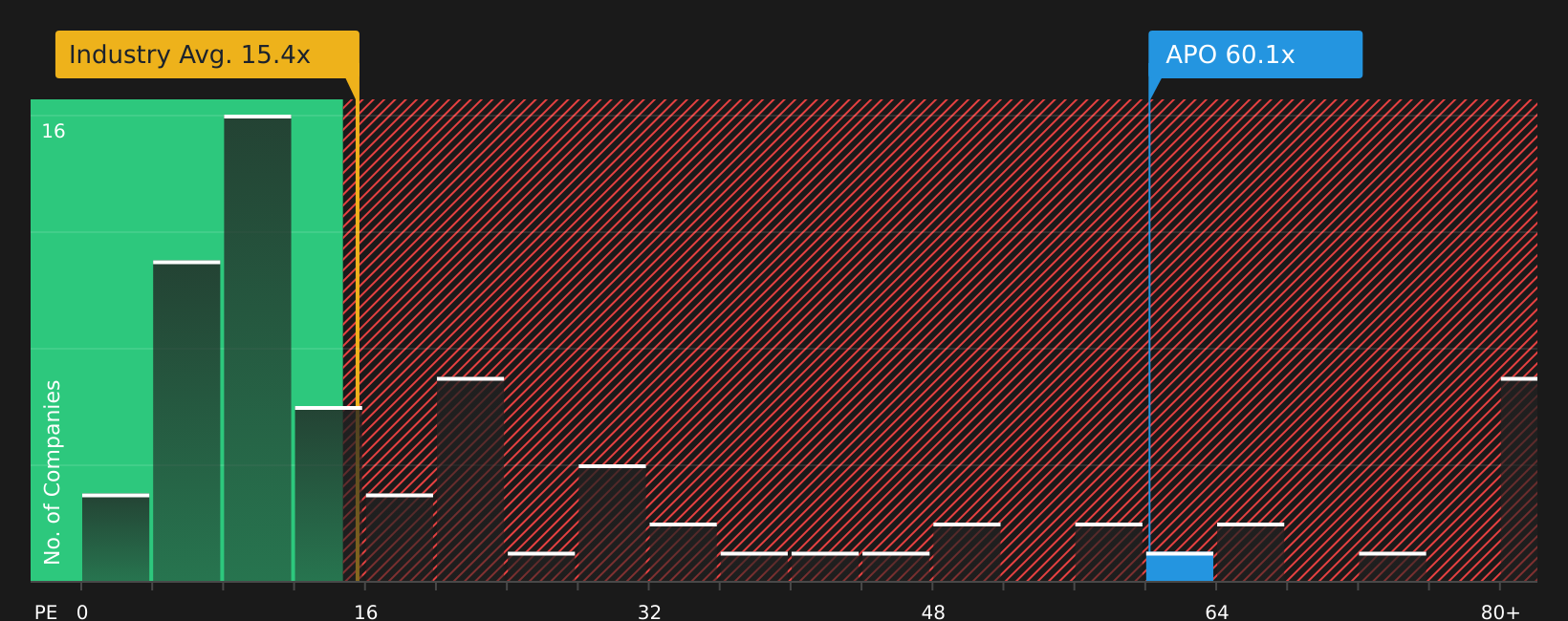
Apollo Global Management sits at the crossroads of higher-for-longer inflation risk, evolving Fed policy and the rise of private credit, which has become a key funding source as banks pull back. The company is active across large, complex financings and acquisitions, from airline bids and sports franchises to B2B media platforms. These activities can create fee and carry opportunities when public markets are less liquid. At the same time, earnings expectations, a high P/E multiple, balance sheet leverage and liquidity management in its private credit funds mean you are paying for an ambitious growth story with real execution and funding risks. For investors who want to understand whether that trade off still looks attractive as policy and liquidity conditions change, Apollo deserves a closer look.
Apollo’s accelerating push into private credit and complex financings can look compelling at a rich P/E, but the real story sits in the 3 key rewards and 3 important warning signs
SoFi Technologies (SOFI)
Overview: SoFi Technologies is a San Francisco based digital finance company that combines an online bank for consumers with a technology platform that powers banking and payments for other institutions, offering products that let members borrow, save, spend, invest and protect their money in a single app.
Operations: SoFi generates revenue primarily from Lending at about US$2.1b, alongside Financial Services at about US$1.6b and its Technology Platform at about US$0.4b, partly offset by Corporate and other items.
Market Cap: US$22.9b
SoFi Technologies sits on the fault line of Fed policy and the credit cycle, as a digital bank that lives on net interest margins, loan quality and the cost of funding. The company has grown its member base to nearly 15 million and is leaning into AI tools and new products such as small business loans and ETFs. However, the stock trades on a rich P/E while profitability metrics, funding structure and past dilution keep risk firmly on the table. With Fed policy in flux, SoFi could see both pressure and relief across its loan book and deposits. Investors who want to understand whether the mix of high growth expectations, banking exposure and platform ambitions still adds up have plenty more to unpack in the full story.
SoFi’s rapid member growth and rich P/E can look like a pure momentum story, but the real tension is where growth meets balance sheet and dilution risk, sitting inside the 2 key rewards and 2 important warning signs (1 is major!)

Blue Owl Capital (OWL)
Overview: Blue Owl Capital is a New York based alternative asset manager that provides permanent capital and private financing solutions, including direct lending, GP stakes, and net lease real estate, to middle market companies, large asset managers, and corporate real estate owners.
Operations: Blue Owl generates about US$2.9b of revenue from asset management services to clients, all reported from the United States.
Market Cap: US$15.1b
Blue Owl Capital gives you exposure to private credit and real assets at a time when the Fed, inflation and bank lending are all under the microscope, and borrowers are increasingly turning to non bank lenders for funding. The company collects mostly fee based revenue from permanent capital vehicles, with growth initiatives in digital infrastructure and healthcare real estate that tie directly into long term demand for data centers and essential services. At the same time, a high P/E, heavy use of debt, dividend coverage concerns and recent fund withdrawal caps underline the funding and liquidity risks that come with this model. For investors weighing whether the combination of high earnings growth forecasts and Fed sensitive private markets is worth those trade offs, there is more to unpack in the full Blue Owl story.
Blue Owl Capital’s fee-heavy permanent capital model can appear to support private credit growth, but investors may be overlooking how its earnings outlook is connected to liquidity pressure and debt use inside the analyst forecasts for Blue Owl Capital.

The three large cap U.S. financial stocks in this article are only a starting point, and the full screener surfaced 10 more companies in the Large-Cap U.S. Financials screener that carry equally compelling stories around Fed policy, inflation, private credit and digital banking. Use Simply Wall St to analyze and filter these large cap financial stocks by the specific catalysts and narratives that matter to you, so you can identify your highest conviction ideas with confidence.
Take Control of Your Investment Journey
If Apollo Global Management or any of these companies sound like a great opportunity, register for FREE with Simply Wall St and add your companies to a Watchlist to monitor the share price against the fair value the ideal entry point. Once you've made your move, manage your holdings with our Portfolio Command Center that filters out the noise to deliver only the most critical, actionable updates. Throughout your journey, our Community allows you to filter the best ideas from thousands of investor perspectives. By uncovering hidden catalysts and risks early, you'll accelerate your decision-making and stay one step ahead of the market.
Seeking Fresh Alternatives Beyond These Stocks?
Some of the most interesting breakouts start quietly, with momentum building before the crowd catches on and prices start moving. Identify fresh ideas while it matters and consider them early in your research process.
- Identify under the radar quality by scanning a curated 20 high quality undiscovered gems that surfaces companies with strong fundamentals before they appear on more investor screens.
- Turn volatility into a research opportunity by tracking 18 cryptocurrency and blockchain stocks tied to digital assets before sentiment shifts and headlines lead to significant price changes.
- Explore potential income opportunities by reviewing a hand picked 8 dividend fortresses that focuses on companies structured to support higher yields while they remain less widely followed for now.
This article by Simply Wall St is general in nature. We provide commentary based on historical data and analyst forecasts only using an unbiased methodology and our articles are not intended to be financial advice. It does not constitute a recommendation to buy or sell any stock, and does not take account of your objectives, or your financial situation. We aim to bring you long-term focused analysis driven by fundamental data. Note that our analysis may not factor in the latest price-sensitive company announcements or qualitative material. Simply Wall St has no position in any stocks mentioned.
Have feedback on this article? Concerned about the content? Get in touch with us directly. Alternatively, email editorial-team@simplywallst.com