


Amazon (AMZN) Stock Still Looks Below Fair Value As Earnings Trail Cash Flow
Amazon.com stock has delivered an 88.4% return over the past three years, yet current checks suggest the shares may still be trading below an intrinsic value estimate based on a Discounted Cash Flow (DCF) approach and on earnings multiples.
- The 88.4% three year return highlights how strongly the market has rewarded Amazon.com, which puts extra focus on whether today's price still leaves room relative to underlying cash flow potential.
- Heavy spending on AI infrastructure, including cloud, chips and stakes in companies such as Anthropic, can support long term cash generation, while the associated capital needs and execution risks may weigh on how much investors are willing to pay for that growth.
- On Simply Wall St's broader checks, Amazon.com screens as a mixed picture rather than a clear bargain or clear premium, with the company passing 4 of 6 valuation tests, value score 4.
The issue now is whether Amazon.com's current price already reflects this AI heavy investment story, or if the Discounted Cash Flow (DCF) and earnings multiple signals of undervaluation still point to a margin of safety.
Is Amazon.com Still Cheap on Cash Flow?
The Discounted Cash Flow (DCF) model estimates what Amazon.com could be worth today based on projected future cash flows. On the latest twelve month numbers, Amazon.com generated about $37.1b of free cash flow, and the model assumes these cash flows keep growing rather than staying flat or declining.
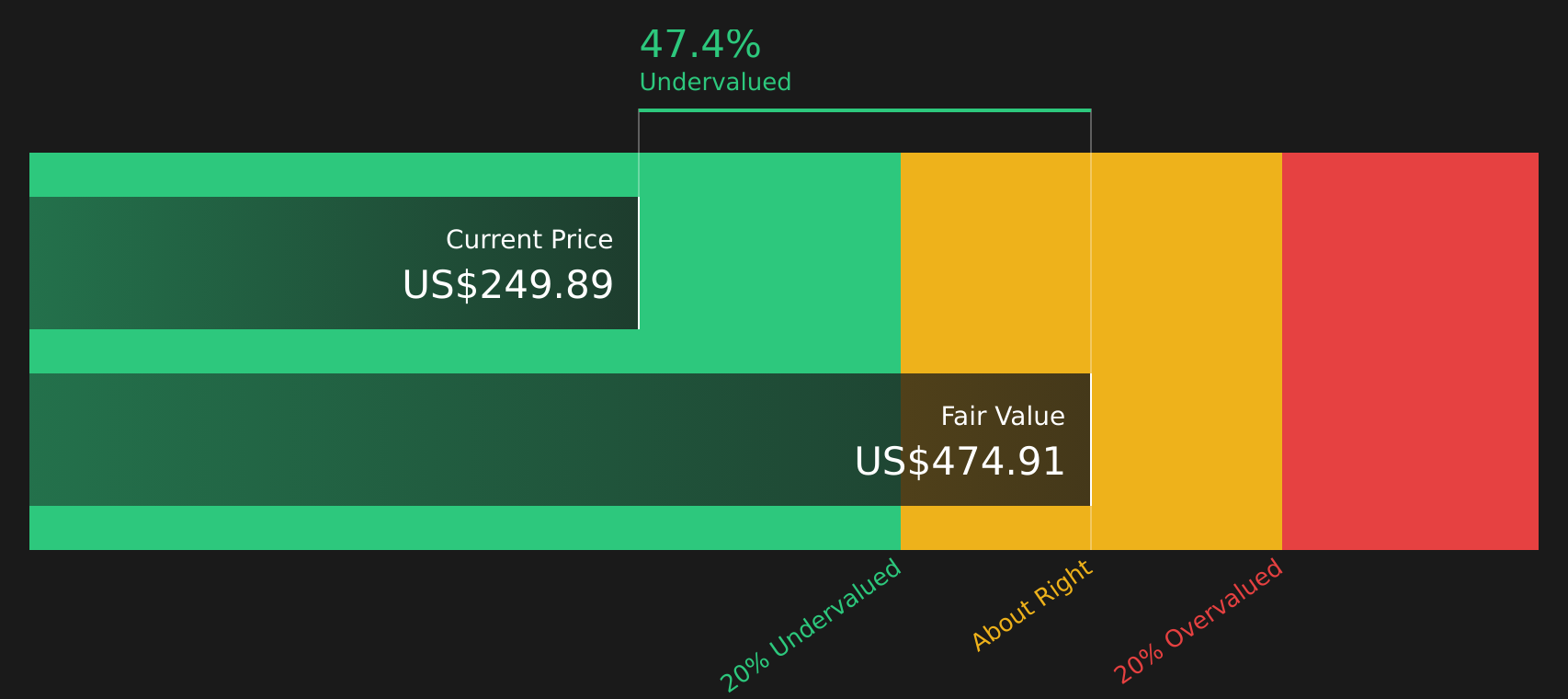
Feeding those projections into a 2 Stage Free Cash Flow to Equity framework gives an estimated intrinsic value of about $475 per share, which sits above the current share price, implying the stock screens as roughly 46.4% undervalued on this method. Amazon's heavy AI and cloud infrastructure spending, including the recently announced $25b bond raise to fund data centers and related projects, helps explain why the market may be applying a discount even though the cash flow model points higher.
On this DCF view, Amazon.com stock appears undervalued relative to the cash flows analysts expect it to generate over time.
Our Discounted Cash Flow (DCF) analysis suggests Amazon.com is undervalued by 46.4%. Track this in your watchlist or portfolio, or discover 47 more high quality undervalued stocks.
Is Amazon.com a Bargain on Earnings?
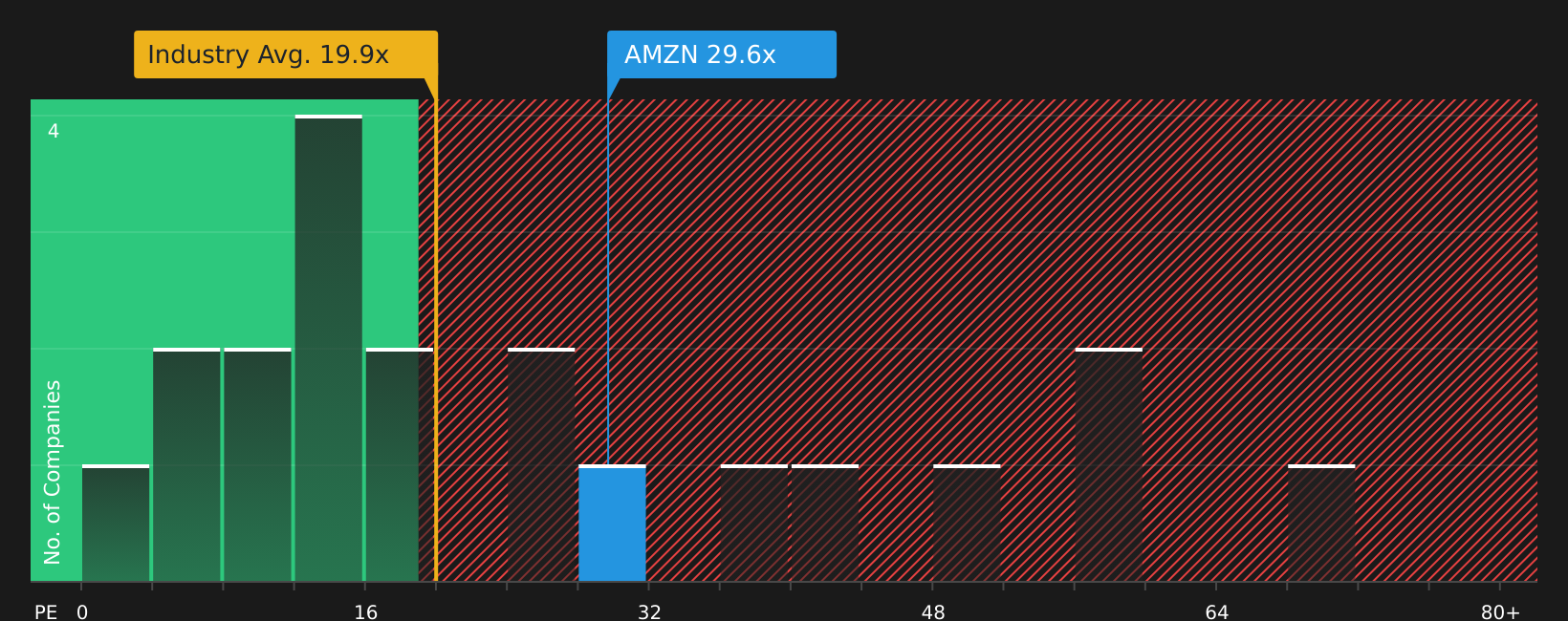
The P/E ratio is a useful way to look at Amazon.com because earnings have become a more important driver of how the stock is priced. Amazon.com currently trades on about 30.2x earnings, which sits close to the 29.2x peer average but meaningfully above the broader Multiline Retail industry average of 20.2x.
Simply Wall St's model suggests a Fair P/E Ratio of 44.4x for Amazon.com, which reflects what investors might be willing to pay for its earnings given its size, margins, business mix and risk profile. Compared with that fair ratio, the present 30.2x multiple implies the stock is trading at a discount, even after considering the premium to the wider retail industry.
On this P/E yardstick, Amazon.com stock appears undervalued relative to the earnings multiple the model suggests investors might be willing to pay.
See what the numbers say about this price — find out in our valuation breakdown.
The Amazon.com Narrative: What Would Justify Today's Price?
Simply Wall St Narratives pick up where the valuation puzzle for Amazon.com leaves off by spelling out which assumptions on future growth, margins and earnings would need to hold for the stock to be worth materially more or less than today's price on the Community page. Each narrative presents its fair value as a thesis about Amazon.com's business that you can revisit over time, rather than a one off snapshot.
Community views on Amazon.com sit far apart, with some investors focused on an AI driven earnings reset and others worried the stock is already pricing in too much.
Bull case: 43% undervalued
"Amazon is sacrificing short-term margins to secure long-duration dominance in AI infrastructure, advertising, and automated commerce..."
Read the full Bull Case to see why Amazon.com could be undervalued
Bear case: 9% overvalued
"The only two negatives I took from it was AWS not growing to revenue expectations and then also during the Q and A they were asked about AI innovation and so on, and they never really never answered the questions and were just very vague..."
Read the full Bear Case to see why Amazon.com could be overvalued
Do you think there's more to the story for Amazon.com? Head over to our Community to see what others are saying!
The Bottom Line
For Amazon.com, both the Discounted Cash Flow (DCF) intrinsic value estimate and the earnings multiple view point to the stock screening as undervalued, even though the broader checks come through as a mixed picture rather than a clear green light. That leaves you weighing whether the market is simply cautious about the capital intensity and execution risk of Amazon.com's AI and cloud build out, or correctly discounting those factors. The key question from here is whether that heavy investment translates into durable cash flow and earnings that justify a higher valuation multiple over time, rather than staying a persistent value trap concern.
This article by Simply Wall St is general in nature. We provide commentary based on historical data and analyst forecasts only using an unbiased methodology and our articles are not intended to be financial advice. It does not constitute a recommendation to buy or sell any stock, and does not take account of your objectives, or your financial situation. We aim to bring you long-term focused analysis driven by fundamental data. Note that our analysis may not factor in the latest price-sensitive company announcements or qualitative material. Simply Wall St has no position in any stocks mentioned.
Have feedback on this article? Concerned about the content? Get in touch with us directly. Alternatively, email editorial-team@simplywallst.com