


Bloom Energy Is Expanding This Key AI Power Partnership to $25 Billion. Time to Buy the Fuel Cell Stock?
Key Points
Bloom Energy entered a strategic partnership with Brookfield in 2025, which was recently expanded from $5 billion to $25 billion.
The deal is a financing framework, not immediate revenue.
The stock recently fell on negative news, creating a buying opportunity for long-term investors.
Take a second and imagine the nearly 3,000 data centers currently under construction or planned in the U.S. all being finished at about, or nearly about, the same time. What a great day for artificial intelligence (AI) companies that will be, right? Yes, but only if they can solve a pesky bottleneck that threatens to derail their plans: power supply.
Let me rephrase the problem like this (and then we'll get to the stock under consideration): A hyperscale data center can take about two to three years to finish, yet it can take anywhere from four to five years or more to connect that center to the electric grid.
Missed Nvidia in 2009? This Rare Signal Is Flashing Again. In 2009, a "Double Down" signal flashed for a little-known chipmaker called Nvidia. For the first time in years, that same "Total Conviction" signal is flashing for a company 1/100th the size of Nvidia. Continue »
Those aren't numbers I pulled out of my head. They come from a recent article published in Energy Reports, which also adds this as a solution: "To address this challenge, scalable transmission switchyards and on-site power generation solutions are critical."
I don't write much about "scalable transmission switchyards" (yet), but one company I cover has been supplying "on-site power generation" to customers for years. That stock is Bloom Energy (NYSE: BE), and the rampant data center build-out mentioned above has just helped them expand a multibillion-dollar agreement fivefold.
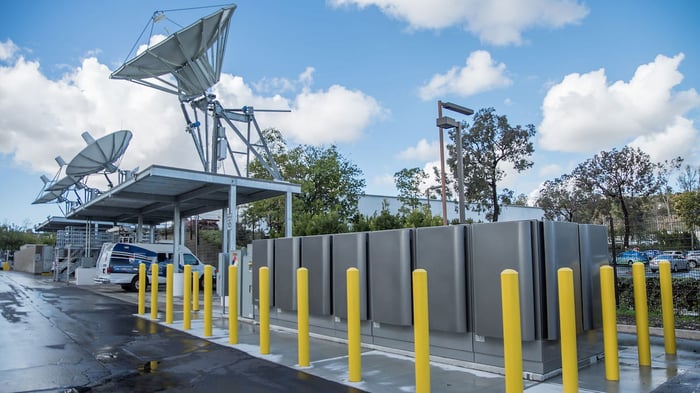
Image source: Bloom Energy.
A financing framework that removes a major hurdle
Bloom Energy sells solid oxide fuel-cell systems -- essentially modular boxes that produce on-site power. These boxes, or servers, essentially convert fuel such as natural gas into electricity without combustion. The company has already deployed servers at over a thousand sites in nine countries, and, as its recent deals suggest, deployments could accelerate considerably.
Last October, Bloom announced a partnership with Brookfield Asset Management (NYSE: BAM). Under the terms of this agreement, Brookfield committed up to $5 billion to finance deployments of Bloom's fuel cell technology and named Bloom its preferred provider of on-site power for AI infrastructure.
Recently, at the end of June, Brookfield decided that demand for data centers wasn't weakening and expanded the original financing deal to $25 billion.
Obviously, $25 billion sounds like a lot. But don't overlook that important qualifier. This deal is a financing framework, not a commitment to revenue. Bloom isn't getting $25 billion upfront from Brookfield. Instead, it's getting a promise that Brookfield will help potential customers of Bloom finance the fuel cell maker's servers, which aren't cheap.
That financing can turn into revenue over time, but it's important that investors don't mistake it for sales yet.
Is it time to buy the fuel cell stock?
Bloom stock has fallen about 29% since the news broke, mainly due to general market volatility and a recent short-seller report. As such, Bloom currently trades around its level at the beginning of June, just before it climbed 40%.
For long-term investors, now might be a good time to buy Bloom. The demand for on-site power generation isn't going away anytime soon, and the Brookfield financing is making it easier for potential customers to adopt Bloom's technology. Expect short-term volatility, but over the long run, this energy stock is poised for growth.
Steven Porrello has positions in Bloom Energy. The Motley Fool has positions in and recommends Bloom Energy and Brookfield Asset Management. The Motley Fool has a disclosure policy.