


Should S&P’s Credit Downgrade and Margin Concerns Require Action From Harley-Davidson (HOG) Investors?
- In recent days, S&P Global Ratings downgraded Harley-Davidson’s credit rating to BB+, flagging concerns about its push into more affordable bikes and ongoing margin pressure.
- This shift highlights a tension between Harley-Davidson’s effort to broaden its customer base and the financial risks attached to changing its long-standing business model.
- Next, we’ll assess how S&P’s downgrade and the worries about margin resilience may reshape Harley-Davidson’s existing investment narrative.
The future of work is here. Discover the 31 top robotics and automation stocks leading the charge in AI-driven automation and industrial transformation.
Harley-Davidson Investment Narrative Recap
To own Harley-Davidson today, you need to believe the brand can widen its customer base with more affordable bikes without permanently sacrificing profitability. S&P’s move to cut the credit rating to BB+ sharpens the focus on this balance, but it does not fundamentally alter the near term catalyst, which is whether Harley can stabilize demand and margins, nor the key risk of continued pressure on core heavyweight sales and pricing.
The most relevant recent development here is Harley’s continued share repurchase activity, with roughly 19.81% of shares bought back under its prior program. This capital return looks more complicated after the downgrade, as weaker credit quality can raise funding costs and constrain financial flexibility, just as the company is trying to support earnings per share and invest in lower price point models that may carry thinner margins.
Yet beneath the appeal of cheaper entry bikes, there is an important risk around margin pressure and credit quality that investors should be aware of...
Read the full narrative on Harley-Davidson (it's free!)
Harley-Davidson's narrative projects $3.9 billion revenue and $231.2 million earnings by 2029.
Uncover how Harley-Davidson's forecasts yield a $25.64 fair value, in line with its current price.
Exploring Other Perspectives
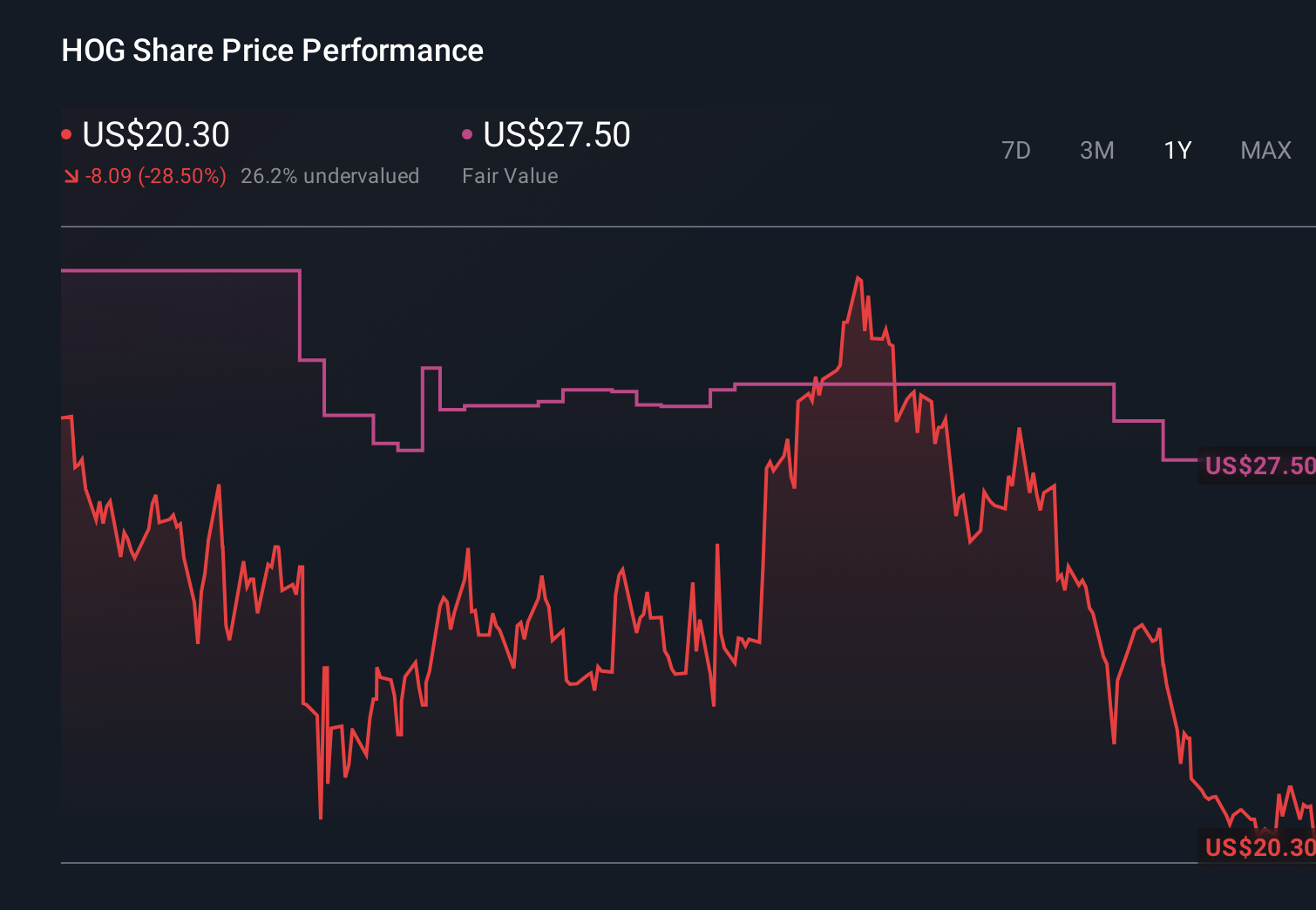
The lowest analysts take a far tougher stance, assuming revenues could fall to about US$3.8 billion and earnings to roughly US$193 million, so you see how their view of margin strain and reinvestment risk paints a much darker picture than the baseline narrative and could shift further after the downgrade.
Explore 4 other fair value estimates on Harley-Davidson - why the stock might be worth as much as 27% more than the current price!
The Verdict Is Yours
Don't just follow the ticker - dig into the data and build a conviction that's truly your own.
- A great starting point for your Harley-Davidson research is our analysis highlighting 3 key rewards and 1 important warning sign that could impact your investment decision.
- Our free Harley-Davidson research report provides a comprehensive fundamental analysis summarized in a single visual - the Snowflake - making it easy to evaluate Harley-Davidson's overall financial health at a glance.
Interested In Other Possibilities?
These stocks are moving-our analysis flagged them today. Act fast before the price catches up:
- Explore 26 top quantum computing companies leading the revolution in next-gen technology and shaping the future with breakthroughs in quantum algorithms, superconducting qubits, and cutting-edge research.
- Outshine the giants: these 16 early-stage AI stocks could fund your retirement.
- We've uncovered the 9 dividend fortresses yielding 5%+ that don't just survive market storms, but thrive in them.
This article by Simply Wall St is general in nature. We provide commentary based on historical data and analyst forecasts only using an unbiased methodology and our articles are not intended to be financial advice. It does not constitute a recommendation to buy or sell any stock, and does not take account of your objectives, or your financial situation. We aim to bring you long-term focused analysis driven by fundamental data. Note that our analysis may not factor in the latest price-sensitive company announcements or qualitative material. Simply Wall St has no position in any stocks mentioned.
Have feedback on this article? Concerned about the content? Get in touch with us directly. Alternatively, email editorial-team@simplywallst.com