
 Nasdaq
 华尔街日报
华尔街日报Many Still Looking Away From Zett Corporation (TSE:8135)
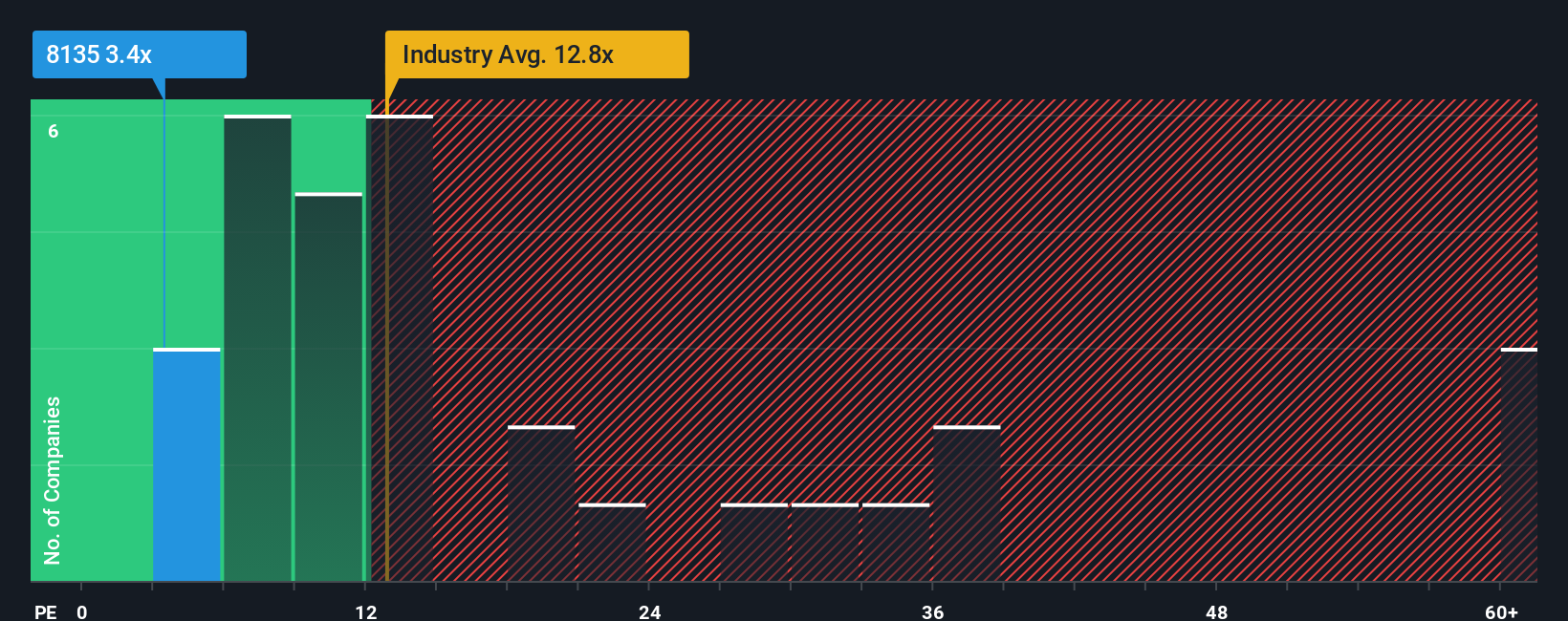
With a price-to-earnings (or "P/E") ratio of 3.4x Zett Corporation (TSE:8135) may be sending very bullish signals at the moment, given that almost half of all companies in Japan have P/E ratios greater than 15x and even P/E's higher than 23x are not unusual. However, the P/E might be quite low for a reason and it requires further investigation to determine if it's justified.
Recent times have been quite advantageous for Zett as its earnings have been rising very briskly. It might be that many expect the strong earnings performance to degrade substantially, which has repressed the P/E. If you like the company, you'd be hoping this isn't the case so that you could potentially pick up some stock while it's out of favour.
View our latest analysis for Zett
What Are Growth Metrics Telling Us About The Low P/E?
In order to justify its P/E ratio, Zett would need to produce anemic growth that's substantially trailing the market.
Taking a look back first, we see that the company grew earnings per share by an impressive 247% last year. The strong recent performance means it was also able to grow EPS by 244% in total over the last three years. Therefore, it's fair to say the earnings growth recently has been superb for the company.
Weighing that recent medium-term earnings trajectory against the broader market's one-year forecast for expansion of 8.9% shows it's noticeably more attractive on an annualised basis.
In light of this, it's peculiar that Zett's P/E sits below the majority of other companies. Apparently some shareholders believe the recent performance has exceeded its limits and have been accepting significantly lower selling prices.
The Key Takeaway
Typically, we'd caution against reading too much into price-to-earnings ratios when settling on investment decisions, though it can reveal plenty about what other market participants think about the company.
We've established that Zett currently trades on a much lower than expected P/E since its recent three-year growth is higher than the wider market forecast. When we see strong earnings with faster-than-market growth, we assume potential risks are what might be placing significant pressure on the P/E ratio. It appears many are indeed anticipating earnings instability, because the persistence of these recent medium-term conditions would normally provide a boost to the share price.
It's always necessary to consider the ever-present spectre of investment risk. We've identified 3 warning signs with Zett (at least 1 which makes us a bit uncomfortable), and understanding them should be part of your investment process.
If these risks are making you reconsider your opinion on Zett, explore our interactive list of high quality stocks to get an idea of what else is out there.
Have feedback on this article? Concerned about the content? Get in touch with us directly. Alternatively, email editorial-team (at) simplywallst.com.
This article by Simply Wall St is general in nature. We provide commentary based on historical data and analyst forecasts only using an unbiased methodology and our articles are not intended to be financial advice. It does not constitute a recommendation to buy or sell any stock, and does not take account of your objectives, or your financial situation. We aim to bring you long-term focused analysis driven by fundamental data. Note that our analysis may not factor in the latest price-sensitive company announcements or qualitative material. Simply Wall St has no position in any stocks mentioned.