
 Nasdaq
 华尔街日报
华尔街日报China In-Tech Limited (HKG:464) May Have Run Too Fast Too Soon With Recent 25% Price Plummet
China In-Tech Limited (HKG:464) shares have retraced a considerable 25% in the last month, reversing a fair amount of their solid recent performance. Nonetheless, the last 30 days have barely left a scratch on the stock's annual performance, which is up a whopping 842%.
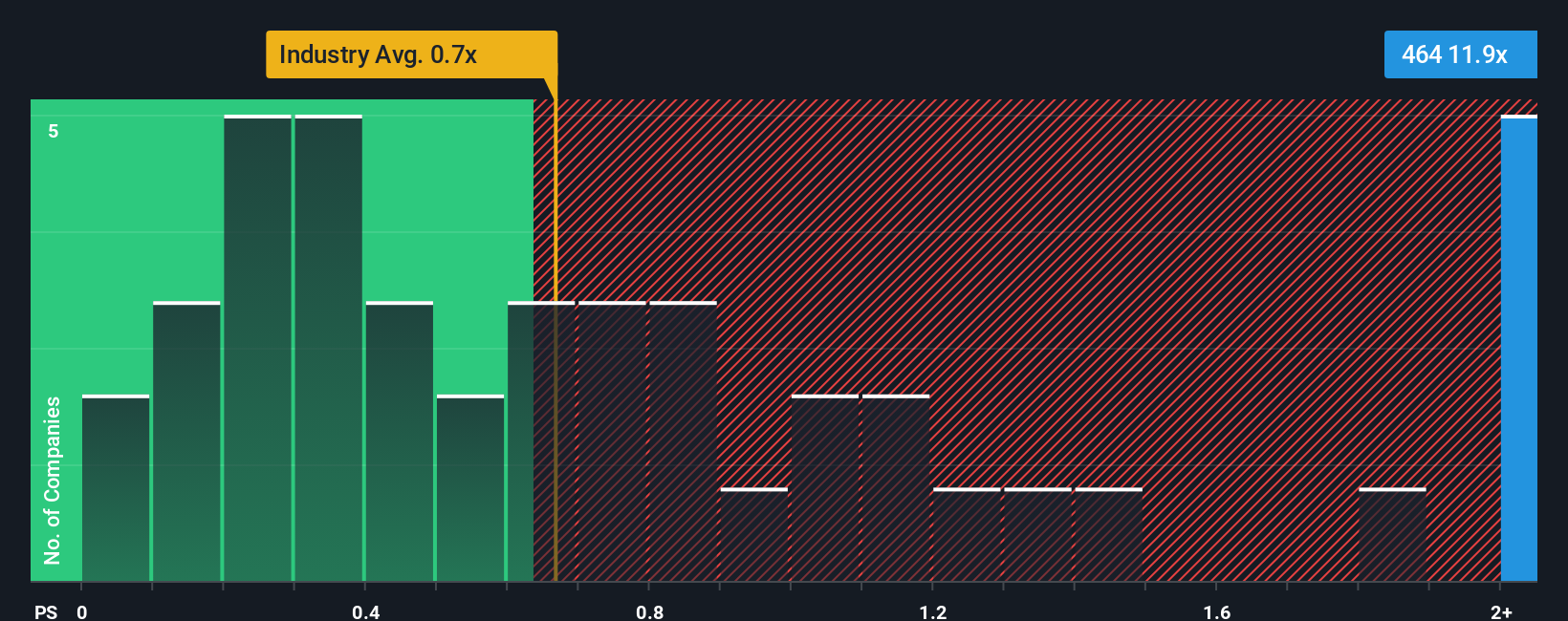
Although its price has dipped substantially, when almost half of the companies in Hong Kong's Consumer Durables industry have price-to-sales ratios (or "P/S") below 0.7x, you may still consider China In-Tech as a stock not worth researching with its 11.9x P/S ratio. Nonetheless, we'd need to dig a little deeper to determine if there is a rational basis for the highly elevated P/S.
View our latest analysis for China In-Tech
How China In-Tech Has Been Performing
For example, consider that China In-Tech's financial performance has been poor lately as its revenue has been in decline. One possibility is that the P/S is high because investors think the company will still do enough to outperform the broader industry in the near future. You'd really hope so, otherwise you're paying a pretty hefty price for no particular reason.
We don't have analyst forecasts, but you can see how recent trends are setting up the company for the future by checking out our free report on China In-Tech's earnings, revenue and cash flow.Is There Enough Revenue Growth Forecasted For China In-Tech?
In order to justify its P/S ratio, China In-Tech would need to produce outstanding growth that's well in excess of the industry.
Retrospectively, the last year delivered a frustrating 45% decrease to the company's top line. As a result, revenue from three years ago have also fallen 59% overall. Accordingly, shareholders would have felt downbeat about the medium-term rates of revenue growth.
Weighing that medium-term revenue trajectory against the broader industry's one-year forecast for expansion of 9.6% shows it's an unpleasant look.
In light of this, it's alarming that China In-Tech's P/S sits above the majority of other companies. It seems most investors are ignoring the recent poor growth rate and are hoping for a turnaround in the company's business prospects. There's a very good chance existing shareholders are setting themselves up for future disappointment if the P/S falls to levels more in line with the recent negative growth rates.
What Does China In-Tech's P/S Mean For Investors?
Even after such a strong price drop, China In-Tech's P/S still exceeds the industry median significantly. Typically, we'd caution against reading too much into price-to-sales ratios when settling on investment decisions, though it can reveal plenty about what other market participants think about the company.
Our examination of China In-Tech revealed its shrinking revenue over the medium-term isn't resulting in a P/S as low as we expected, given the industry is set to grow. With a revenue decline on investors' minds, the likelihood of a souring sentiment is quite high which could send the P/S back in line with what we'd expect. Should recent medium-term revenue trends persist, it would pose a significant risk to existing shareholders' investments and prospective investors will have a hard time accepting the current value of the stock.
Before you take the next step, you should know about the 4 warning signs for China In-Tech (3 are potentially serious!) that we have uncovered.
If you're unsure about the strength of China In-Tech's business, why not explore our interactive list of stocks with solid business fundamentals for some other companies you may have missed.
Have feedback on this article? Concerned about the content? Get in touch with us directly. Alternatively, email editorial-team (at) simplywallst.com.
This article by Simply Wall St is general in nature. We provide commentary based on historical data and analyst forecasts only using an unbiased methodology and our articles are not intended to be financial advice. It does not constitute a recommendation to buy or sell any stock, and does not take account of your objectives, or your financial situation. We aim to bring you long-term focused analysis driven by fundamental data. Note that our analysis may not factor in the latest price-sensitive company announcements or qualitative material. Simply Wall St has no position in any stocks mentioned.