
 Nasdaq
 华尔街日报
华尔街日报Is Deere’s Recent Share Price Pause Creating a Long Term Opportunity in 2025
How Has Deere's Share Price Been Performing?
After a strong multi year run, Deere's share price has been more range bound recently, which can make it harder for investors to judge whether the current level really offers good value. To set the scene for a valuation deep dive, it helps to look at how the stock has actually been behaving.
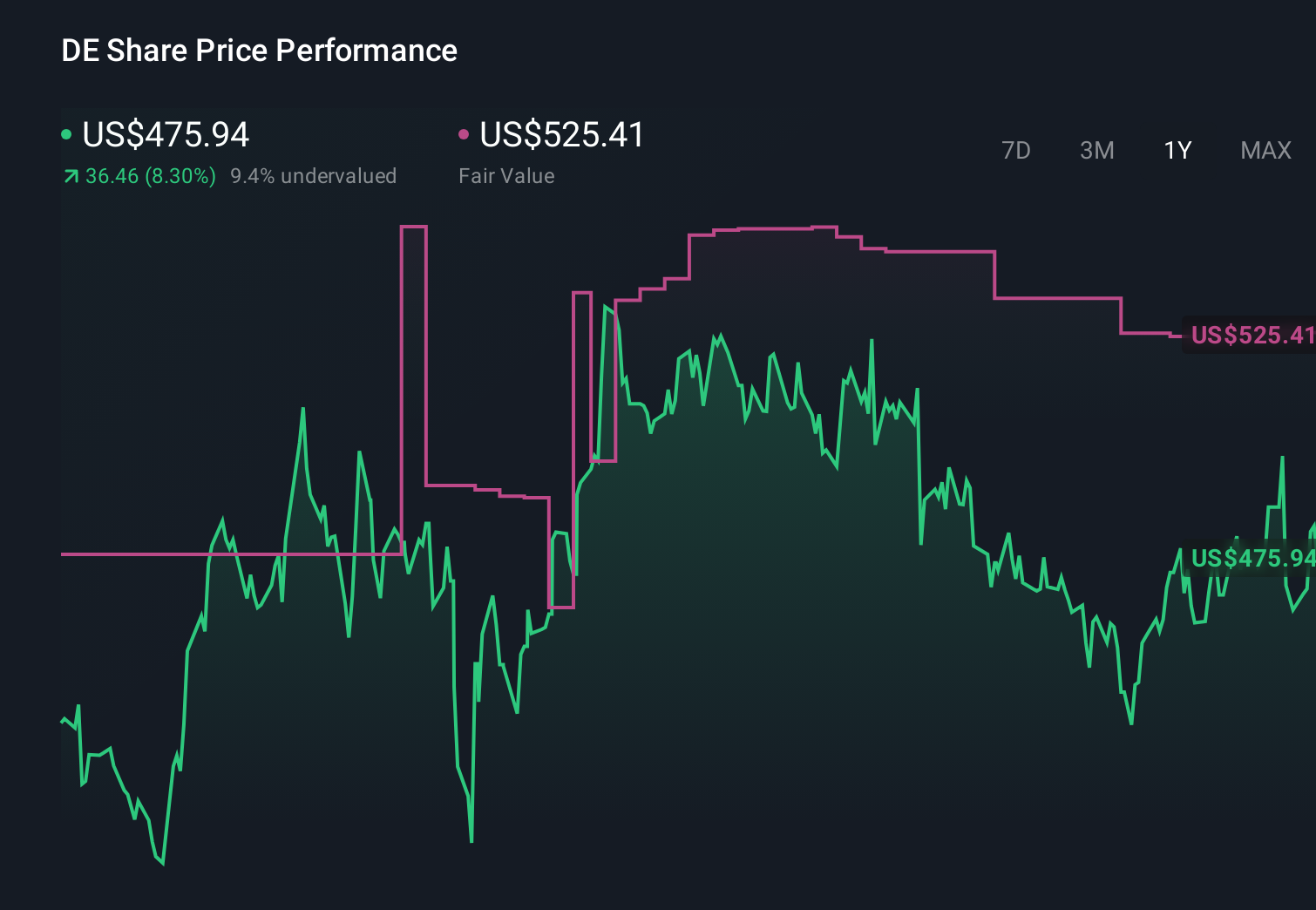
Over the last year, Deere has delivered a total return of 9.5%, with shares up 11.8% year to date despite some recent softness. In the shorter term, the stock has slipped 2.8% over the past week and 4.1% over the last month, a reminder that even quality industrial names can go through bouts of volatility.
Zooming out further, the longer term picture still looks constructive, with 13.2% annualised returns over three years and an 86.8% gain over five years. That combination of solid long term performance and recent consolidation leaves investors asking whether the current price is a pause before the next leg higher or a signal that expectations have caught up with reality.
For valuation focused investors, this performance profile matters because it can hint at how much future growth the market has already priced in. The next step is to compare Deere's fundamentals with its share price to see whether the recent cooling in momentum has created an opportunity or simply brought the stock closer to fair value.
Find out why Deere's 9.5% return over the last year is lagging behind its peers.
Approach 1: Deere Discounted Cash Flow (DCF) Analysis
A Discounted Cash Flow model estimates what a business is worth by projecting the cash it can generate in the future and then discounting those cash flows back to today in dollar terms. For Deere, the 2 Stage Free Cash Flow to Equity model starts with last twelve month free cash flow of about $3.6 billion and uses analyst forecasts for the next few years, with Simply Wall St extrapolating growth further out.
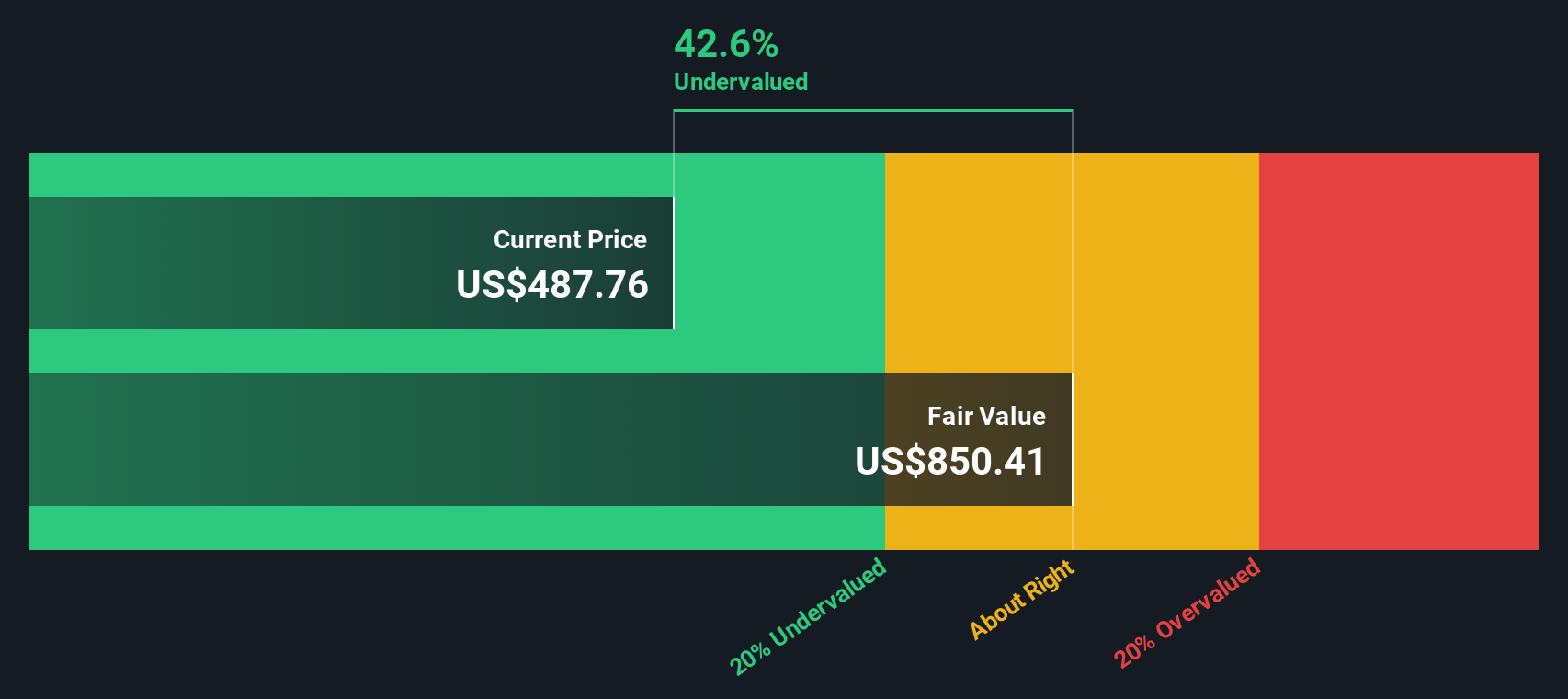
On this basis, Deere's free cash flow is projected to rise to around $12.4 billion by 2030, with the later years in the model growing more moderately as the business matures. When those future cash flows are discounted back to today, the model produces an intrinsic value of about $628 per share.
Compared with the current share price, this implies the stock is roughly 25.6% undervalued, suggesting the market is not fully pricing in Deere's cash generation potential.
Result: UNDERVALUED
Our Discounted Cash Flow (DCF) analysis suggests Deere is undervalued by 25.6%. Track this in your watchlist or portfolio, or discover 904 more undervalued stocks based on cash flows.
Approach 2: Deere Price vs Earnings
For profitable, established businesses like Deere, the price to earnings ratio is often the most intuitive way to judge valuation because it links what investors pay today with the profits the company is already generating. In general, faster growth and lower risk justify a higher normal PE, while slower growth or higher uncertainty usually call for a lower multiple.
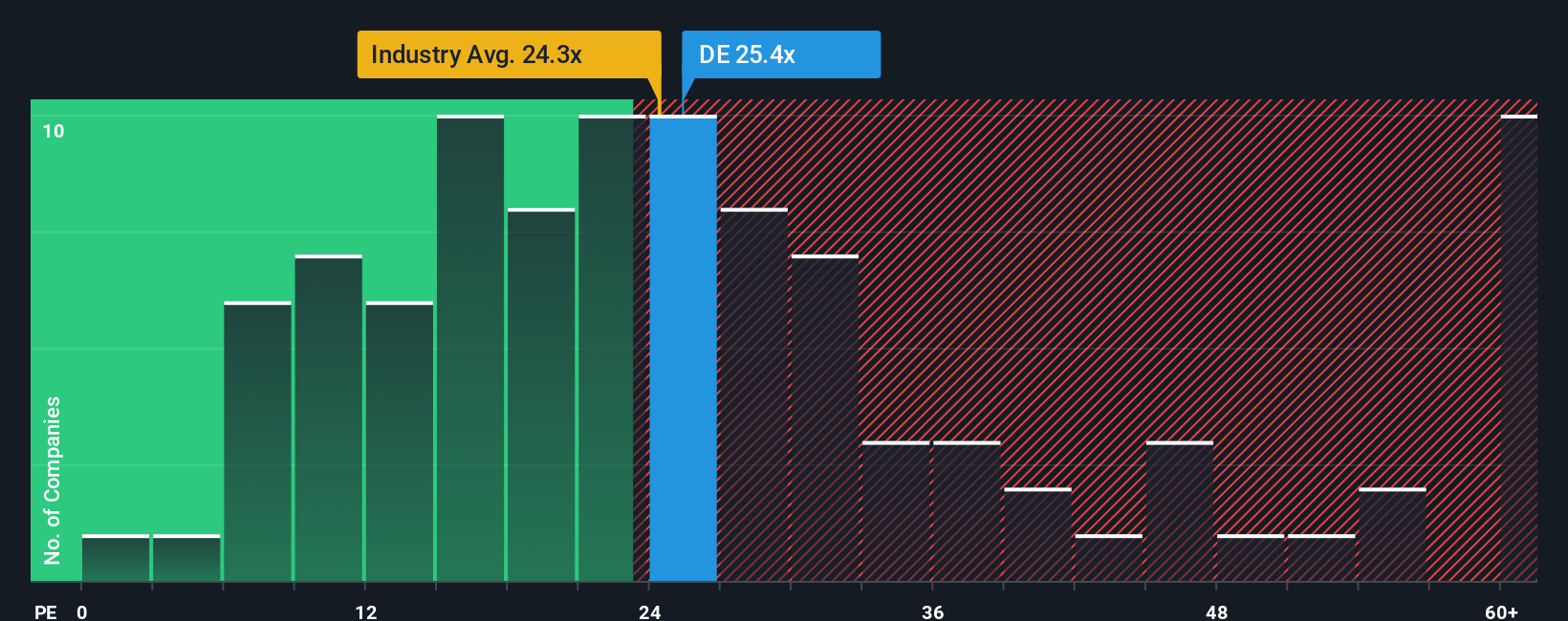
Deere currently trades on a PE of about 25.1x, which is close to the Machinery industry average of roughly 25.5x and slightly above the peer group average of around 23.9x. Simply Wall St also calculates a Fair Ratio of 34.4x, which is a proprietary estimate of what Deere's PE could be once you factor in its earnings growth outlook, profitability, industry, market cap and specific risks.
This Fair Ratio can be more informative than a simple peer or industry comparison because it adjusts for Deere's own characteristics rather than assuming all machinery stocks warrant similar multiples. With the current PE of 25.1x sitting below the Fair Ratio of 34.4x, the shares appear attractively priced on an earnings basis.
Result: UNDERVALUED
PE ratios tell one story, but what if the real opportunity lies elsewhere? Discover 1460 companies where insiders are betting big on explosive growth.
Upgrade Your Decision Making: Choose your Deere Narrative
Earlier we mentioned that there is an even better way to understand valuation, so let us introduce you to Narratives. These are simple, story driven forecasts that let you connect your view of Deere’s business to specific assumptions for future revenue, earnings and margins, and then translate that into a Fair Value you can compare with today’s share price on Simply Wall St’s Community page, where millions of investors share their views. For example, one Deere Narrative might lean bullish, expecting precision agriculture subscriptions, global farm recovery and margin expansion to support a Fair Value closer to the high end of recent analyst targets near $724. A more cautious Narrative could stress tariffs, cyclical pressure and competitive pricing to anchor Fair Value nearer the low end around $460. Because these Narratives update dynamically as new earnings, news or guidance arrives, they provide an accessible, always current framework to decide when the gap between your Fair Value and the market price suggests it may be time to buy, hold or sell.
Do you think there's more to the story for Deere? Head over to our Community to see what others are saying!
This article by Simply Wall St is general in nature. We provide commentary based on historical data and analyst forecasts only using an unbiased methodology and our articles are not intended to be financial advice. It does not constitute a recommendation to buy or sell any stock, and does not take account of your objectives, or your financial situation. We aim to bring you long-term focused analysis driven by fundamental data. Note that our analysis may not factor in the latest price-sensitive company announcements or qualitative material. Simply Wall St has no position in any stocks mentioned.
Have feedback on this article? Concerned about the content? Get in touch with us directly. Alternatively, email editorial-team@simplywallst.com