
 Nasdaq
 华尔街日报
华尔街日报United Airlines Holdings, Inc. (NASDAQ:UAL) Surges 26% Yet Its Low P/E Is No Reason For Excitement
United Airlines Holdings, Inc. (NASDAQ:UAL) shareholders would be excited to see that the share price has had a great month, posting a 26% gain and recovering from prior weakness. Taking a wider view, although not as strong as the last month, the full year gain of 17% is also fairly reasonable.
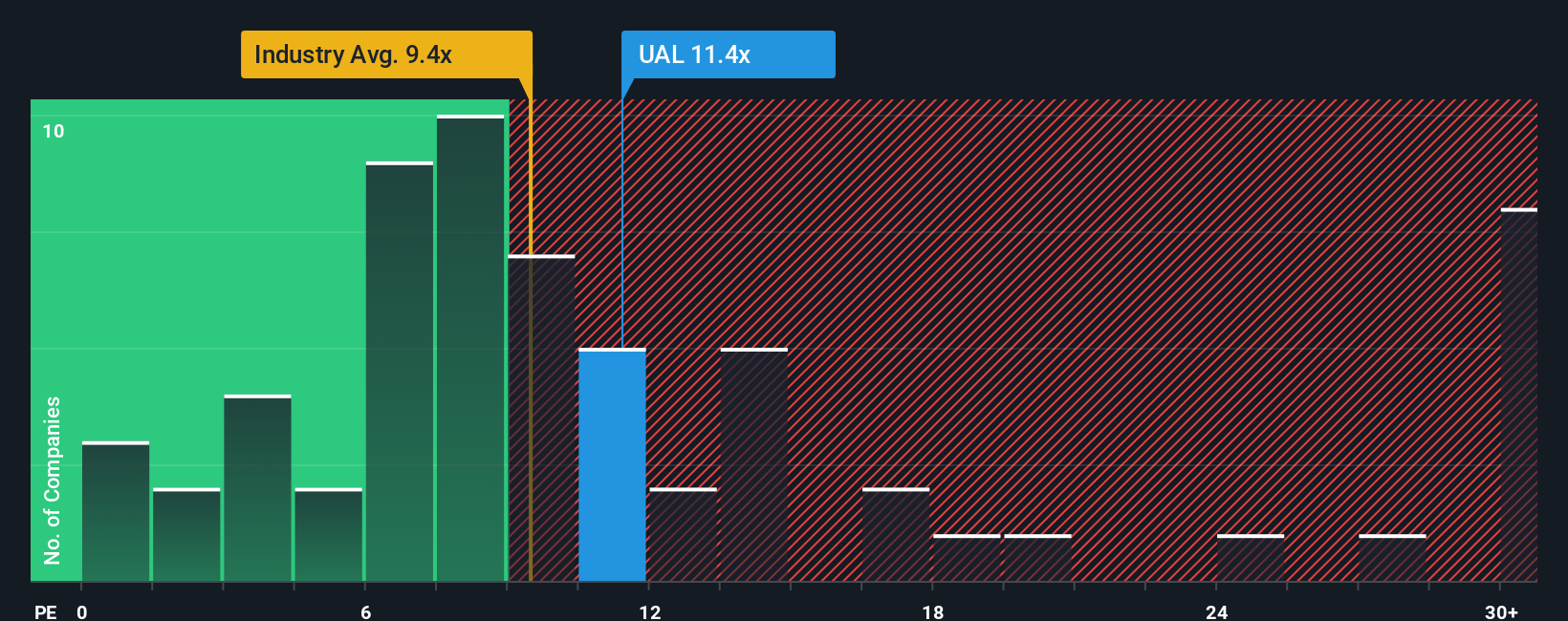
Even after such a large jump in price, United Airlines Holdings' price-to-earnings (or "P/E") ratio of 11.4x might still make it look like a buy right now compared to the market in the United States, where around half of the companies have P/E ratios above 20x and even P/E's above 34x are quite common. Although, it's not wise to just take the P/E at face value as there may be an explanation why it's limited.
With earnings growth that's superior to most other companies of late, United Airlines Holdings has been doing relatively well. It might be that many expect the strong earnings performance to degrade substantially, which has repressed the P/E. If you like the company, you'd be hoping this isn't the case so that you could potentially pick up some stock while it's out of favour.
View our latest analysis for United Airlines Holdings
How Is United Airlines Holdings' Growth Trending?
The only time you'd be truly comfortable seeing a P/E as low as United Airlines Holdings' is when the company's growth is on track to lag the market.
Retrospectively, the last year delivered an exceptional 20% gain to the company's bottom line. However, the latest three year period hasn't been as great in aggregate as it didn't manage to provide any growth at all. So it appears to us that the company has had a mixed result in terms of growing earnings over that time.
Turning to the outlook, the next three years should generate growth of 7.8% per annum as estimated by the analysts watching the company. That's shaping up to be materially lower than the 11% per annum growth forecast for the broader market.
With this information, we can see why United Airlines Holdings is trading at a P/E lower than the market. It seems most investors are expecting to see limited future growth and are only willing to pay a reduced amount for the stock.
What We Can Learn From United Airlines Holdings' P/E?
United Airlines Holdings' stock might have been given a solid boost, but its P/E certainly hasn't reached any great heights. Using the price-to-earnings ratio alone to determine if you should sell your stock isn't sensible, however it can be a practical guide to the company's future prospects.
As we suspected, our examination of United Airlines Holdings' analyst forecasts revealed that its inferior earnings outlook is contributing to its low P/E. Right now shareholders are accepting the low P/E as they concede future earnings probably won't provide any pleasant surprises. It's hard to see the share price rising strongly in the near future under these circumstances.
Before you settle on your opinion, we've discovered 1 warning sign for United Airlines Holdings that you should be aware of.
You might be able to find a better investment than United Airlines Holdings. If you want a selection of possible candidates, check out this free list of interesting companies that trade on a low P/E (but have proven they can grow earnings).
Have feedback on this article? Concerned about the content? Get in touch with us directly. Alternatively, email editorial-team (at) simplywallst.com.
This article by Simply Wall St is general in nature. We provide commentary based on historical data and analyst forecasts only using an unbiased methodology and our articles are not intended to be financial advice. It does not constitute a recommendation to buy or sell any stock, and does not take account of your objectives, or your financial situation. We aim to bring you long-term focused analysis driven by fundamental data. Note that our analysis may not factor in the latest price-sensitive company announcements or qualitative material. Simply Wall St has no position in any stocks mentioned.