
 Nasdaq
 华尔街日报
华尔街日报What SM Entertainment Co., Ltd.'s (KOSDAQ:041510) P/S Is Not Telling You
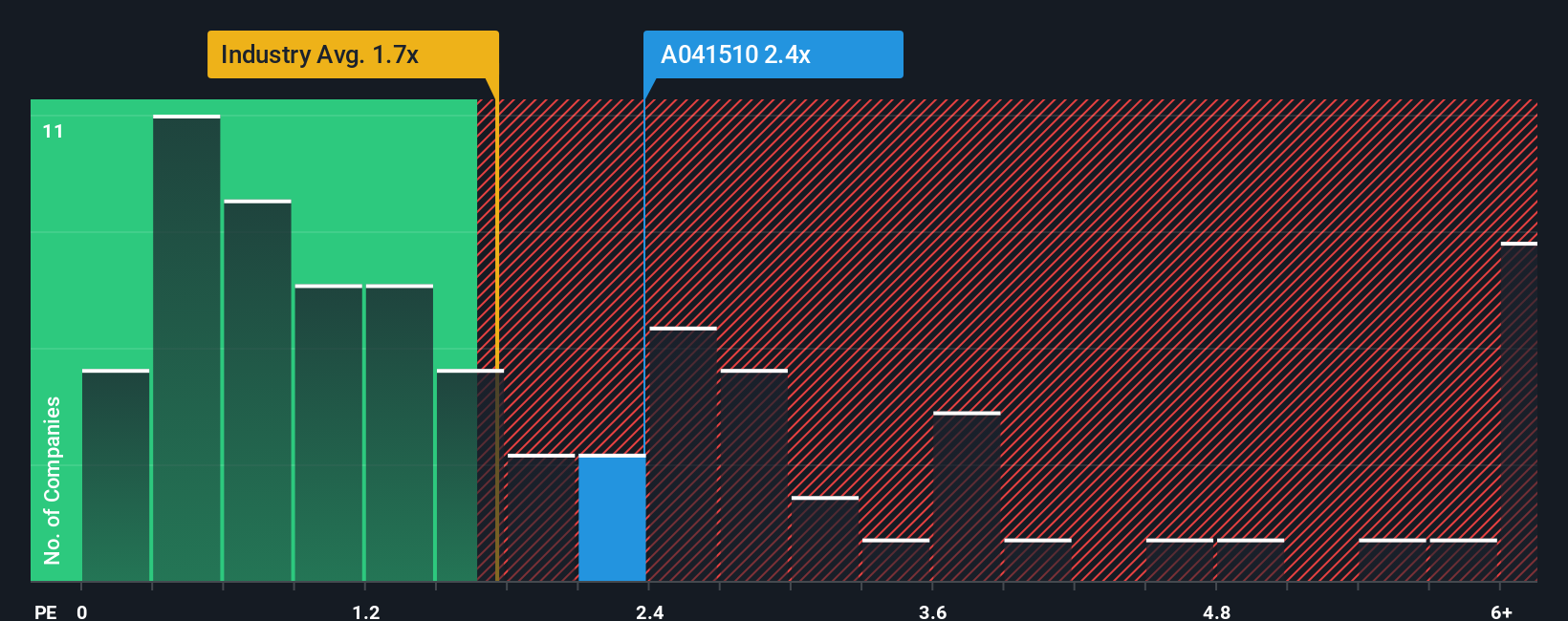
When you see that almost half of the companies in the Entertainment industry in Korea have price-to-sales ratios (or "P/S") below 1.7x, SM Entertainment Co., Ltd. (KOSDAQ:041510) looks to be giving off some sell signals with its 2.4x P/S ratio. Nonetheless, we'd need to dig a little deeper to determine if there is a rational basis for the elevated P/S.
View our latest analysis for SM Entertainment
What Does SM Entertainment's Recent Performance Look Like?
Recent times have been advantageous for SM Entertainment as its revenues have been rising faster than most other companies. It seems the market expects this form will continue into the future, hence the elevated P/S ratio. You'd really hope so, otherwise you're paying a pretty hefty price for no particular reason.
If you'd like to see what analysts are forecasting going forward, you should check out our free report on SM Entertainment.Do Revenue Forecasts Match The High P/S Ratio?
SM Entertainment's P/S ratio would be typical for a company that's expected to deliver solid growth, and importantly, perform better than the industry.
Retrospectively, the last year delivered an exceptional 17% gain to the company's top line. The strong recent performance means it was also able to grow revenue by 40% in total over the last three years. Accordingly, shareholders would have definitely welcomed those medium-term rates of revenue growth.
Looking ahead now, revenue is anticipated to climb by 10% each year during the coming three years according to the analysts following the company. That's shaping up to be similar to the 10% per year growth forecast for the broader industry.
In light of this, it's curious that SM Entertainment's P/S sits above the majority of other companies. It seems most investors are ignoring the fairly average growth expectations and are willing to pay up for exposure to the stock. Although, additional gains will be difficult to achieve as this level of revenue growth is likely to weigh down the share price eventually.
The Key Takeaway
Using the price-to-sales ratio alone to determine if you should sell your stock isn't sensible, however it can be a practical guide to the company's future prospects.
Seeing as its revenues are forecast to grow in line with the wider industry, it would appear that SM Entertainment currently trades on a higher than expected P/S. The fact that the revenue figures aren't setting the world alight has us doubtful that the company's elevated P/S can be sustainable for the long term. A positive change is needed in order to justify the current price-to-sales ratio.
We don't want to rain on the parade too much, but we did also find 2 warning signs for SM Entertainment that you need to be mindful of.
If you're unsure about the strength of SM Entertainment's business, why not explore our interactive list of stocks with solid business fundamentals for some other companies you may have missed.
Have feedback on this article? Concerned about the content? Get in touch with us directly. Alternatively, email editorial-team (at) simplywallst.com.
This article by Simply Wall St is general in nature. We provide commentary based on historical data and analyst forecasts only using an unbiased methodology and our articles are not intended to be financial advice. It does not constitute a recommendation to buy or sell any stock, and does not take account of your objectives, or your financial situation. We aim to bring you long-term focused analysis driven by fundamental data. Note that our analysis may not factor in the latest price-sensitive company announcements or qualitative material. Simply Wall St has no position in any stocks mentioned.