
 Nasdaq
 华尔街日报
华尔街日报1 High-Yield Dividend Stock I'd Buy Before ConocoPhillips in 2026
Key Points
ConocoPhillips’s elite upstream portfolio allows it to rake in free cash flow, even at mediocre oil and gas prices.
Chevron is more geographically diverse and has a higher yield.
Both stocks are good buys for value investors.
Where to invest $1,000 right now? Our analyst team just revealed what they believe are the 10 best stocks to buy right now. Continue »
2025 has been a rough year for energy stocks, as oil prices just hit four-year lows and the broader energy sector is up a little over 1% year to date (YTD). Meanwhile, ConocoPhillips (NYSE: COP) stock price is down 8.5% year to date.
ConocoPhillips is the most valuable U.S. exploration and production (E&P) company by market capitalization, with an emphasis on onshore production in the U.S. Here's why it's my top upstream oil and gas stock to buy in 2026, and one slightly better buy for investors looking for a reliable dividend-paying stock in the new year.
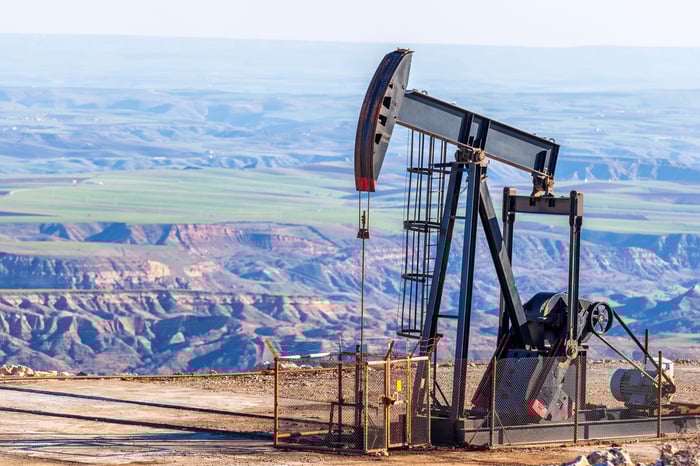
Image source: Getty Images.
A top E&P for 2026
ConocoPhillips is an incredibly well-run company that has done a masterful job of lowering its operating costs through internal improvements and savvy acquisitions -- like acquiring Marathon Oil in 2024 and Concho Resources in 2021.
In its most recent quarter, ConocoPhillips had an average realized price per barrel of oil equivalent (boe) of just $46.44, compared to $54.18 per boe in the third quarter of 2024. Boe combines oil and natural gas into a single metric, providing a more accurate representation of total production for oil and gas companies with substantial natural gas reserves.
In the first nine months of 2025, ConocoPhillips generated a whopping $15.55 billion in cash from operations, funded $9.5 billion of capital expenditures (capex) and investments, bought back $4 billion in stock, paid $3 billion in dividends, and retired $700 million in debt. And that's despite years of declining boe prices.
Better yet, ConocoPhillips expects $7 billion in incremental free cash flow (FCF) from 2025 to 2029, including $1 billion each year from 2026 through 2028 and then a ramp-up in 2029 as its Willow Project in Alaska comes online in 2029.
On its third-quarter earnings call, ConocoPhillips said that it expects its FCF breakeven to decline to the low $30 per barrel of West Texas Intermediate (WTI) crude oil by the end of the decade, which should allow the company to achieve its goal of delivering top-quartile dividend growth rate relative to the S&P 500 (SNPINDEX: ^GSPC). ConocoPhillips has been able to lower its break-even point by focusing on high-margin production, which makes the company well-positioned to endure downturns or periods of relatively low oil and gas prices (like we are in now).
A balanced oil major for income investors
ConocoPhillips stands out as one of the best oil and gas stocks to buy for 2026, but not the best. Chevron (NYSE: CVX) is a more balanced buy for long-term investors, especially those looking for a reliable source of passive income.
Like ConocoPhillips, Chevron is entering 2026 with a highly efficient production portfolio that should realize a lower breakeven through 2030 as low-cost projects come online. Through 2030, Chevron is forecasting a capex and dividend breakeven of $50 per Brent Crude Oil barrel. Brent is the international benchmark, whereas WTI is the U.S. benchmark. Chevron is basically saying it can fund its roughly $18 billion to $21 billion capex plans and pay its growing dividend (roughly $13.6 billion per year), even at $50 Brent prices or lower.
For context, Brent prices have only averaged below $50 per barrel two out of the last 10 years -- the pandemic-induced crash of 2020, where Brent averaged $41.96 for the year, and 2016, when the industry was coming out of a downturn and prices averaged $45.13. In years when Brent is below $50, Chevron can rely on its rock-solid balance sheet to fund long-term investors and return capital to shareholders.
Chevron has a more geographically diversified upstream portfolio than ConocoPhillips, a massive downstream refining business, and a growing low-carbon business. It also boasts a stronger dividend track record, having increased its payout for 38 consecutive years and yielding 4.7% compared to ConocoPhillips's less-consistent dividend history and 3.7% yield.
With inexpensive valuations and high yields, ConocoPhillips and Chevron are both excellent buys for 2026, but Chevron gains the edge for folks looking to bolster their passive income stream with a proven winner.
Daniel Foelber has no position in any of the stocks mentioned. The Motley Fool has positions in and recommends Chevron. The Motley Fool recommends ConocoPhillips. The Motley Fool has a disclosure policy.