
 Nasdaq
 华尔街日报
华尔街日报Investment AB Latour (publ) (STO:LATO B) Stock Has Shown Weakness Lately But Financials Look Strong: Should Prospective Shareholders Make The Leap?
Investment AB Latour (STO:LATO B) has had a rough three months with its share price down 5.4%. However, a closer look at its sound financials might cause you to think again. Given that fundamentals usually drive long-term market outcomes, the company is worth looking at. Specifically, we decided to study Investment AB Latour's ROE in this article.
Return on equity or ROE is a key measure used to assess how efficiently a company's management is utilizing the company's capital. Simply put, it is used to assess the profitability of a company in relation to its equity capital.
How Is ROE Calculated?
Return on equity can be calculated by using the formula:
Return on Equity = Net Profit (from continuing operations) ÷ Shareholders' Equity
So, based on the above formula, the ROE for Investment AB Latour is:
12% = kr4.8b ÷ kr42b (Based on the trailing twelve months to September 2025).
The 'return' is the income the business earned over the last year. One way to conceptualize this is that for each SEK1 of shareholders' capital it has, the company made SEK0.12 in profit.
Check out our latest analysis for Investment AB Latour
What Has ROE Got To Do With Earnings Growth?
Thus far, we have learned that ROE measures how efficiently a company is generating its profits. Based on how much of its profits the company chooses to reinvest or "retain", we are then able to evaluate a company's future ability to generate profits. Generally speaking, other things being equal, firms with a high return on equity and profit retention, have a higher growth rate than firms that don’t share these attributes.
Investment AB Latour's Earnings Growth And 12% ROE
To start with, Investment AB Latour's ROE looks acceptable. Even when compared to the industry average of 11% the company's ROE looks quite decent. Given the circumstances, we can't help but wonder why Investment AB Latour saw little to no growth in the past five years. We reckon that there could be some other factors at play here that's limiting the company's growth. For example, it could be that the company has a high payout ratio or the business has allocated capital poorly, for instance.
As a next step, we compared Investment AB Latour's net income growth with the industry and found that the company has a similar growth figure when compared with the industry average growth rate of 1.7% in the same period.
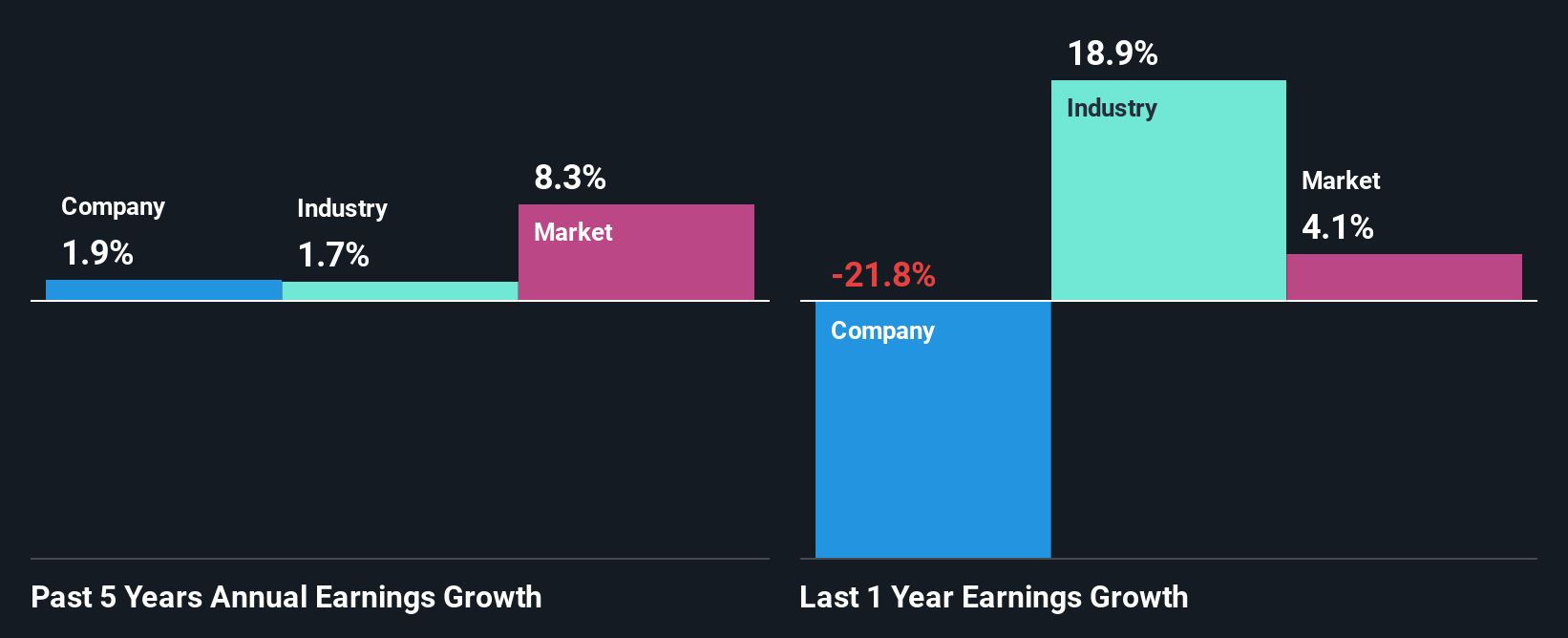
The basis for attaching value to a company is, to a great extent, tied to its earnings growth. The investor should try to establish if the expected growth or decline in earnings, whichever the case may be, is priced in. This then helps them determine if the stock is placed for a bright or bleak future. One good indicator of expected earnings growth is the P/E ratio which determines the price the market is willing to pay for a stock based on its earnings prospects. So, you may want to check if Investment AB Latour is trading on a high P/E or a low P/E, relative to its industry.
Is Investment AB Latour Efficiently Re-investing Its Profits?
Despite having a normal three-year median payout ratio of 47% (implying that the company keeps 53% of its income) over the last three years, Investment AB Latour has seen a negligible amount of growth in earnings as we saw above. So there might be other factors at play here which could potentially be hampering growth. For example, the business has faced some headwinds.
In addition, Investment AB Latour has been paying dividends over a period of at least ten years suggesting that keeping up dividend payments is way more important to the management even if it comes at the cost of business growth.
Conclusion
Overall, we are quite pleased with Investment AB Latour's performance. In particular, it's great to see that the company is investing heavily into its business and along with a high rate of return, that has resulted in a respectable growth in its earnings. Until now, we have only just grazed the surface of the company's past performance by looking at the company's fundamentals. You can do your own research on Investment AB Latour and see how it has performed in the past by looking at this FREE detailed graph of past earnings, revenue and cash flows.
Have feedback on this article? Concerned about the content? Get in touch with us directly. Alternatively, email editorial-team (at) simplywallst.com.
This article by Simply Wall St is general in nature. We provide commentary based on historical data and analyst forecasts only using an unbiased methodology and our articles are not intended to be financial advice. It does not constitute a recommendation to buy or sell any stock, and does not take account of your objectives, or your financial situation. We aim to bring you long-term focused analysis driven by fundamental data. Note that our analysis may not factor in the latest price-sensitive company announcements or qualitative material. Simply Wall St has no position in any stocks mentioned.