
 Nasdaq
 华尔街日报
华尔街日报Has Lilly’s Obesity Drug Boom Pushed Its 2025 Valuation Too Far?
- Wondering if Eli Lilly is still worth buying after its monster run, or if the upside has already been priced in? You are not alone, and that is exactly what this article aims to unpack.
- The stock has climbed 1.7% over the last week, 1.0% in the past month, and is up a hefty 32.1% year to date, building on a 31.2% gain over the last year and an astonishing 531.7% over five years.
- A big part of this momentum has been driven by excitement around Eli Lilly's obesity and diabetes treatments, which investors see as potential long term blockbusters. In addition, regulatory approvals and expanding indications for its key drugs have reinforced the view that its growth runway could be longer than many traditional pharma names.
- Yet, despite all that optimism, our valuation framework gives Eli Lilly a score of 1 out of 6, suggesting it screens as expensive on most traditional metrics. Next, we will walk through the standard valuation approaches investors use for LLY, and then finish with a more holistic way to think about what the market might really be pricing in.
Eli Lilly scores just 1/6 on our valuation checks. See what other red flags we found in the full valuation breakdown.
Approach 1: Eli Lilly Discounted Cash Flow (DCF) Analysis
A Discounted Cash Flow model projects a company’s future cash flows and then discounts them back to today’s value, aiming to estimate what the business is truly worth right now.
For Eli Lilly, the latest twelve month Free Cash Flow is about $6.2 Billion. Analysts and model assumptions see that figure climbing significantly, with projections reaching roughly $37.6 Billion in Free Cash Flow by 2029 and continuing to rise over the following years. These estimates combine analyst forecasts for the next few years with longer term extrapolations by Simply Wall St’s 2 Stage Free Cash Flow to Equity model.
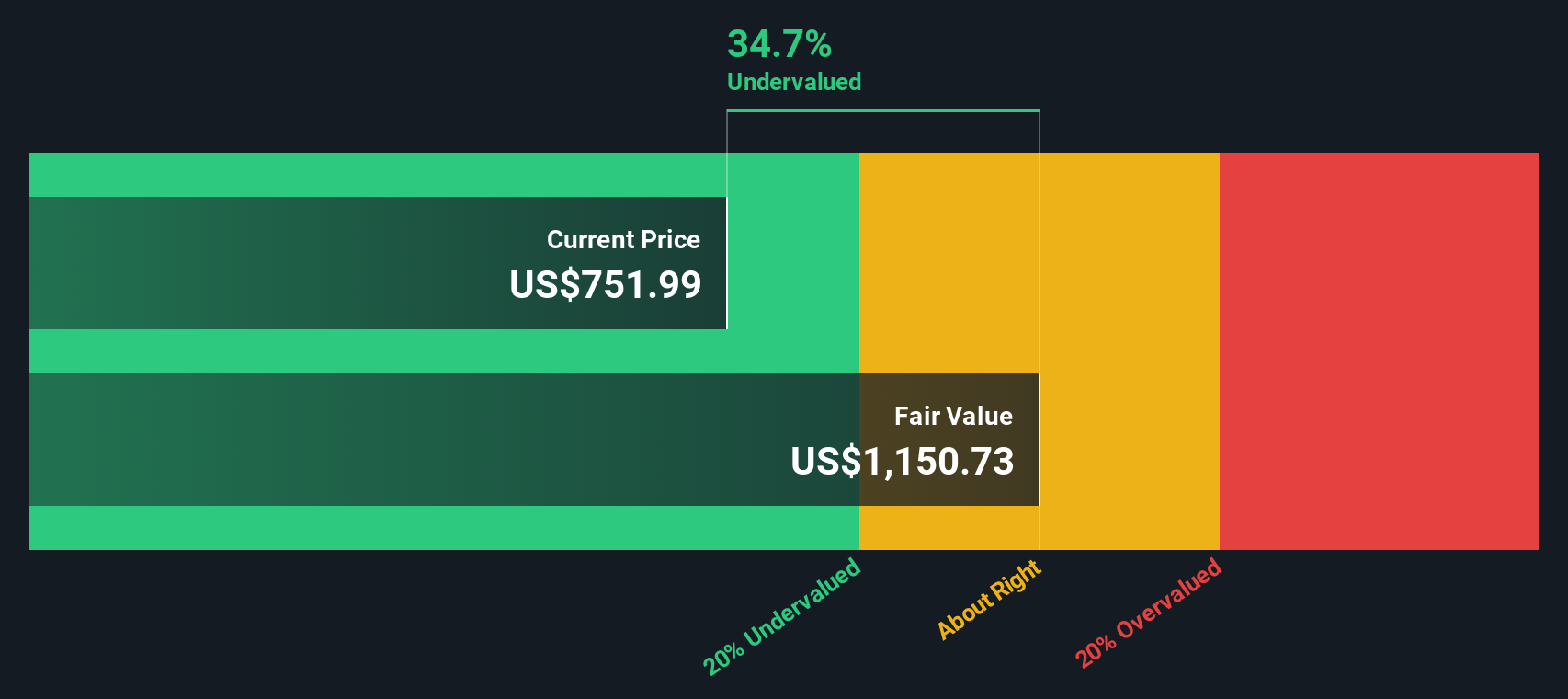
Bringing all those projected cash flows back to today, the DCF model arrives at an intrinsic value of about $1,274 per share. Compared with the current share price, this implies roughly a 19.4% discount, which suggests the market is still not fully pricing in Eli Lilly’s expected cash generation.
Result: UNDERVALUED
Our Discounted Cash Flow (DCF) analysis suggests Eli Lilly is undervalued by 19.4%. Track this in your watchlist or portfolio, or discover 907 more undervalued stocks based on cash flows.
Approach 2: Eli Lilly Price vs Earnings
For profitable companies like Eli Lilly, the price to earnings, or PE, ratio is a straightforward way to gauge how much investors are willing to pay for each dollar of current profits. In general, fast growing, relatively lower risk businesses deserve higher PE multiples, while slower growing or riskier names typically trade on lower ones.
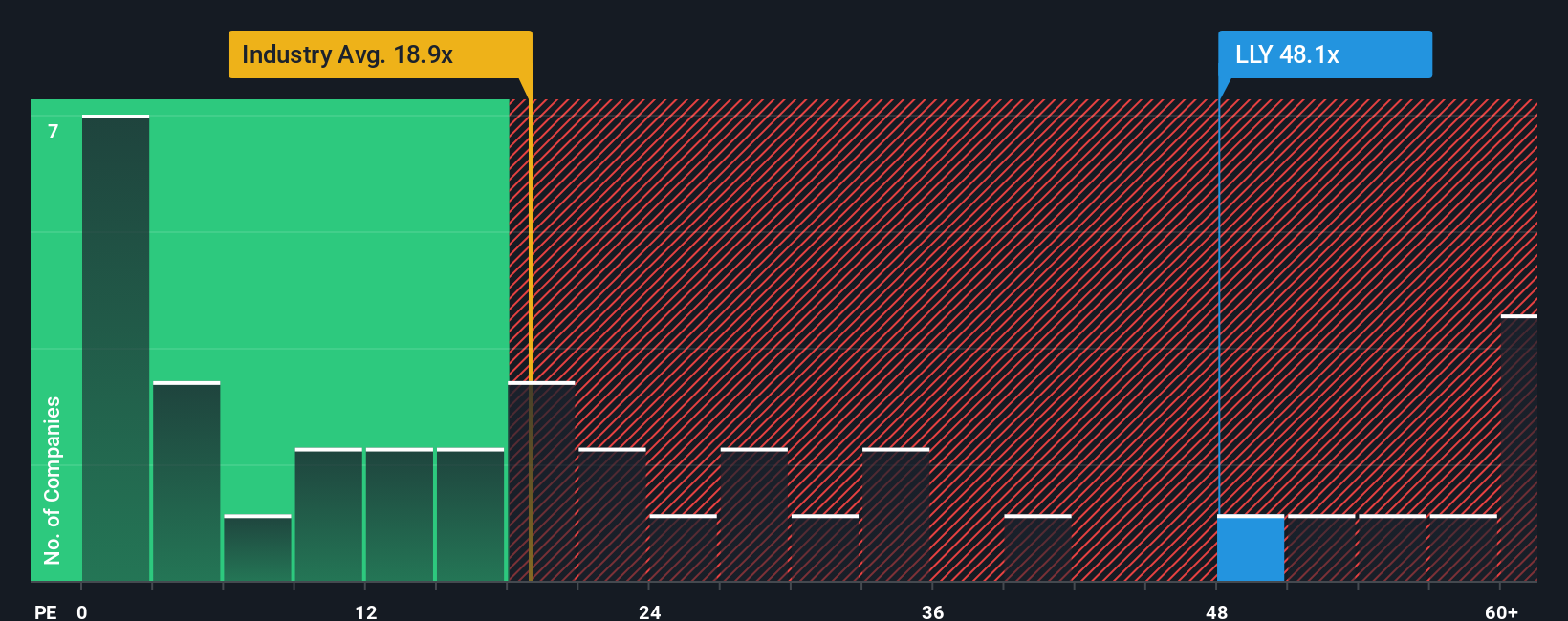
Eli Lilly currently trades on a PE of about 50x, which is well above both the broader Pharmaceuticals industry average of roughly 20x and a peer group average of about 17x. On those basic comparisons alone, the stock looks expensive. That said, these simple benchmarks do not fully capture the company’s exceptional growth outlook, margins, size and risk profile.
Simply Wall St’s Fair Ratio framework tries to solve that problem by estimating what a reasonable PE should be, given factors such as earnings growth, profitability, industry, market cap and risks. For Eli Lilly, the Fair Ratio comes out at roughly 43x. This means the current 50x multiple still sits meaningfully above what those fundamentals would justify, even after accounting for its strengths.
Result: OVERVALUED
PE ratios tell one story, but what if the real opportunity lies elsewhere? Discover 1448 companies where insiders are betting big on explosive growth.
Upgrade Your Decision Making: Choose your Eli Lilly Narrative
Earlier we mentioned that there is an even better way to understand valuation, so let us introduce you to Narratives, a simple way to connect the story you believe about a company with the numbers you are willing to plug into a forecast.
A Narrative is your clearly stated view on what drives a business, linked directly to assumptions about future revenue, earnings and margins, which then flow through to an estimated fair value.
On Simply Wall St, Narratives live inside the Community page and are designed to be easy and accessible, helping millions of investors move beyond raw ratios toward a structured, story plus forecast approach.
Once you have a Narrative, the platform compares its Fair Value to the current market Price so you can quickly see whether your story suggests buying, selling or holding.
Narratives are also dynamic, updating as new information like earnings, news or policy changes arrive, so your fair value view stays current without you rebuilding a model from scratch.
For Eli Lilly for example, one Narrative might assume a fair value near $1,189 with high GLP 1 growth and long exclusivity. Another, more cautious Narrative might sit closer to $650, reflecting worries about pricing pressure, competition and policy risk.
For Eli Lilly however, we will make it really easy for you with previews of two leading Eli Lilly Narratives:
Fair value: $1,189.18
Implied undervaluation vs last close: 13.6%
Assumed revenue growth: 20%
- The tirzepatide franchise, via Mounjaro and Zepbound, is seen as the core long-term growth engine, with demand constrained more by production capacity than by patient interest.
- Strong patent protection, low current GLP 1 penetration in a very large US patient pool, and improving insurance and employer coverage support a long growth runway and pricing power.
- The base case assumes 20% to 25% annual revenue growth over the next several years, with capacity investments easing bottlenecks and supporting a fair value near $1,200.
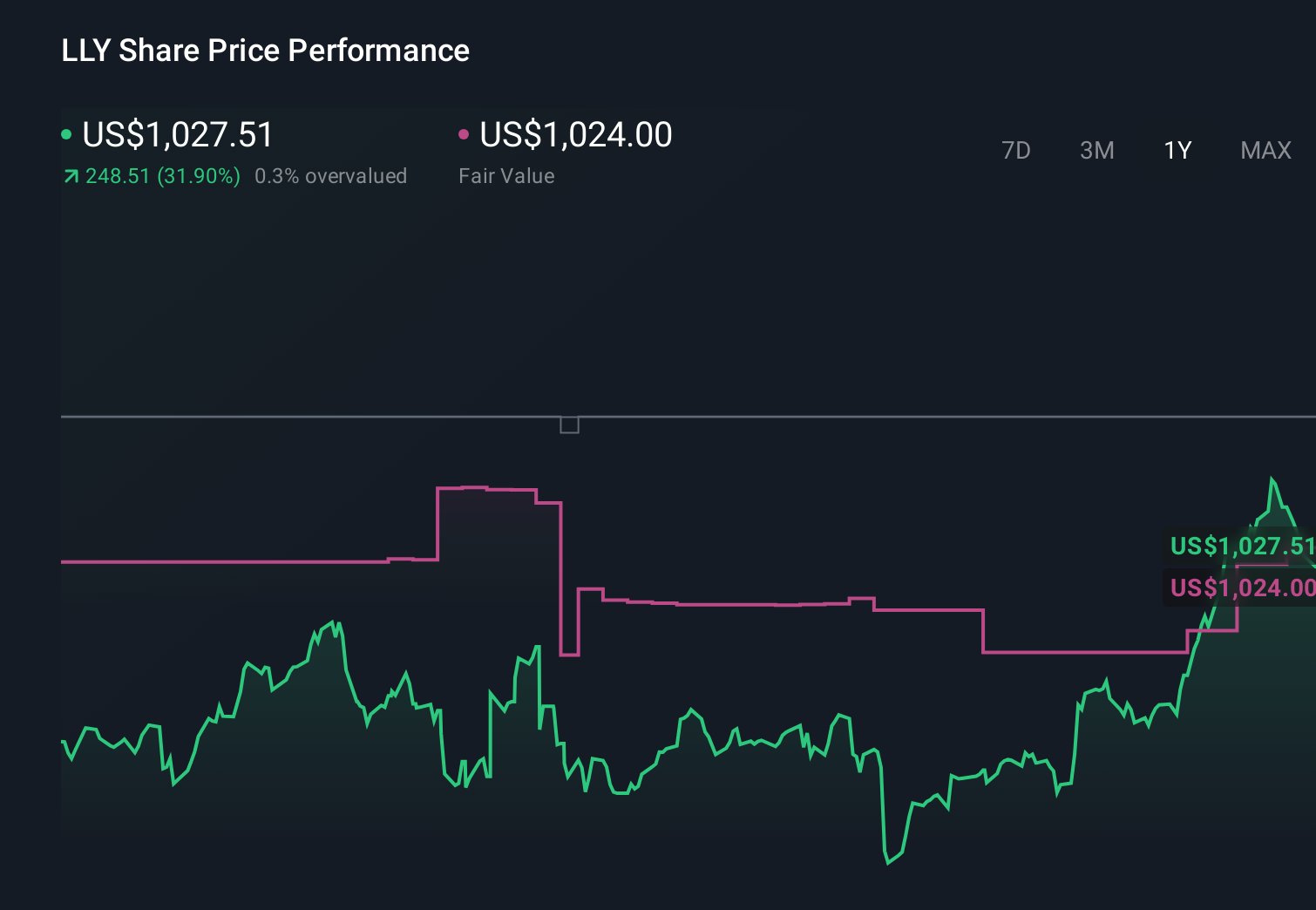
Fair value: $1,024.00
Implied overvaluation vs last close: 0.3%
Assumed revenue growth: 17.48%
- Analysts still forecast mid to high teens revenue growth driven by obesity and diabetes treatments, new indications, and a broad late-stage pipeline.
- However, dependence on a relatively narrow set of blockbuster GLP 1 and cardiometabolic drugs, along with regulatory, reimbursement and competitive pressures, could cap margins and long-term growth.
- A consensus fair value of about $1,024 implies the stock is only slightly above what the narrative supports, so outcomes may depend on whether pricing, policy and competition evolve more favorably or less favorably than expected.
Do you think there's more to the story for Eli Lilly? Head over to our Community to see what others are saying!
This article by Simply Wall St is general in nature. We provide commentary based on historical data and analyst forecasts only using an unbiased methodology and our articles are not intended to be financial advice. It does not constitute a recommendation to buy or sell any stock, and does not take account of your objectives, or your financial situation. We aim to bring you long-term focused analysis driven by fundamental data. Note that our analysis may not factor in the latest price-sensitive company announcements or qualitative material. Simply Wall St has no position in any stocks mentioned.
Have feedback on this article? Concerned about the content? Get in touch with us directly. Alternatively, email editorial-team@simplywallst.com