
 Nasdaq
 华尔街日报
华尔街日报Should Weakness in Kura Sushi, Inc.'s (TSE:2695) Stock Be Seen As A Sign That Market Will Correct The Share Price Given Decent Financials?
It is hard to get excited after looking at Kura Sushi's (TSE:2695) recent performance, when its stock has declined 21% over the past three months. However, the company's fundamentals look pretty decent, and long-term financials are usually aligned with future market price movements. Particularly, we will be paying attention to Kura Sushi's ROE today.
Return on equity or ROE is an important factor to be considered by a shareholder because it tells them how effectively their capital is being reinvested. Simply put, it is used to assess the profitability of a company in relation to its equity capital.
How Do You Calculate Return On Equity?
ROE can be calculated by using the formula:
Return on Equity = Net Profit (from continuing operations) ÷ Shareholders' Equity
So, based on the above formula, the ROE for Kura Sushi is:
1.8% = JP¥1.5b ÷ JP¥85b (Based on the trailing twelve months to July 2025).
The 'return' is the amount earned after tax over the last twelve months. One way to conceptualize this is that for each ¥1 of shareholders' capital it has, the company made ¥0.02 in profit.
View our latest analysis for Kura Sushi
What Is The Relationship Between ROE And Earnings Growth?
Thus far, we have learned that ROE measures how efficiently a company is generating its profits. Based on how much of its profits the company chooses to reinvest or "retain", we are then able to evaluate a company's future ability to generate profits. Assuming everything else remains unchanged, the higher the ROE and profit retention, the higher the growth rate of a company compared to companies that don't necessarily bear these characteristics.
A Side By Side comparison of Kura Sushi's Earnings Growth And 1.8% ROE
As you can see, Kura Sushi's ROE looks pretty weak. Even compared to the average industry ROE of 12%, the company's ROE is quite dismal. Despite this, surprisingly, Kura Sushi saw an exceptional 24% net income growth over the past five years. We reckon that there could be other factors at play here. Such as - high earnings retention or an efficient management in place.
Next, on comparing with the industry net income growth, we found that Kura Sushi's reported growth was lower than the industry growth of 48% over the last few years, which is not something we like to see.
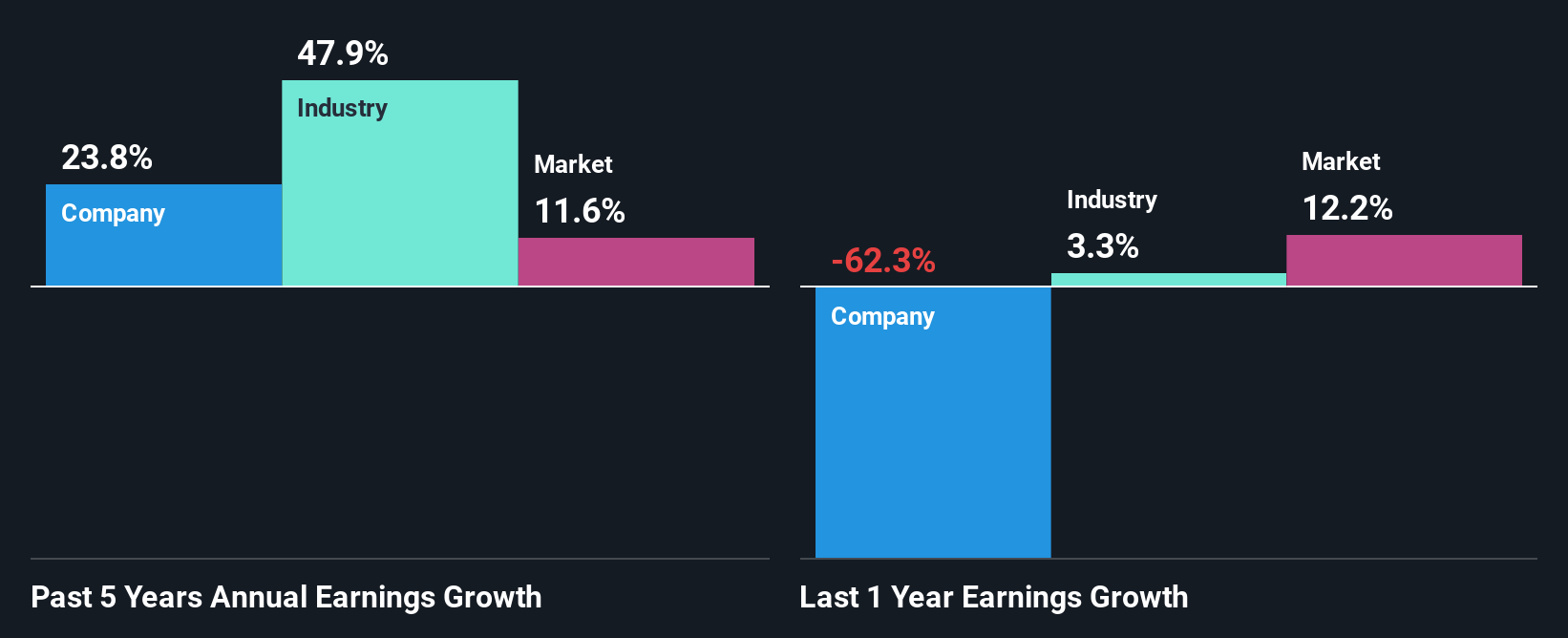
The basis for attaching value to a company is, to a great extent, tied to its earnings growth. The investor should try to establish if the expected growth or decline in earnings, whichever the case may be, is priced in. By doing so, they will have an idea if the stock is headed into clear blue waters or if swampy waters await. Is Kura Sushi fairly valued compared to other companies? These 3 valuation measures might help you decide.
Is Kura Sushi Efficiently Re-investing Its Profits?
The three-year median payout ratio for Kura Sushi is 28%, which is moderately low. The company is retaining the remaining 72%. By the looks of it, the dividend is well covered and Kura Sushi is reinvesting its profits efficiently as evidenced by its exceptional growth which we discussed above.
Besides, Kura Sushi has been paying dividends for at least ten years or more. This shows that the company is committed to sharing profits with its shareholders.
Summary
On the whole, we do feel that Kura Sushi has some positive attributes. Specifically, its fairly high earnings growth number, which no doubt was backed by the company's high earnings retention. Still, the low ROE means that all that reinvestment is not reaping a lot of benefit to the investors. With that said, the latest industry analyst forecasts reveal that the company's earnings growth is expected to slow down. To know more about the company's future earnings growth forecasts take a look at this free report on analyst forecasts for the company to find out more.
Have feedback on this article? Concerned about the content? Get in touch with us directly. Alternatively, email editorial-team (at) simplywallst.com.
This article by Simply Wall St is general in nature. We provide commentary based on historical data and analyst forecasts only using an unbiased methodology and our articles are not intended to be financial advice. It does not constitute a recommendation to buy or sell any stock, and does not take account of your objectives, or your financial situation. We aim to bring you long-term focused analysis driven by fundamental data. Note that our analysis may not factor in the latest price-sensitive company announcements or qualitative material. Simply Wall St has no position in any stocks mentioned.